


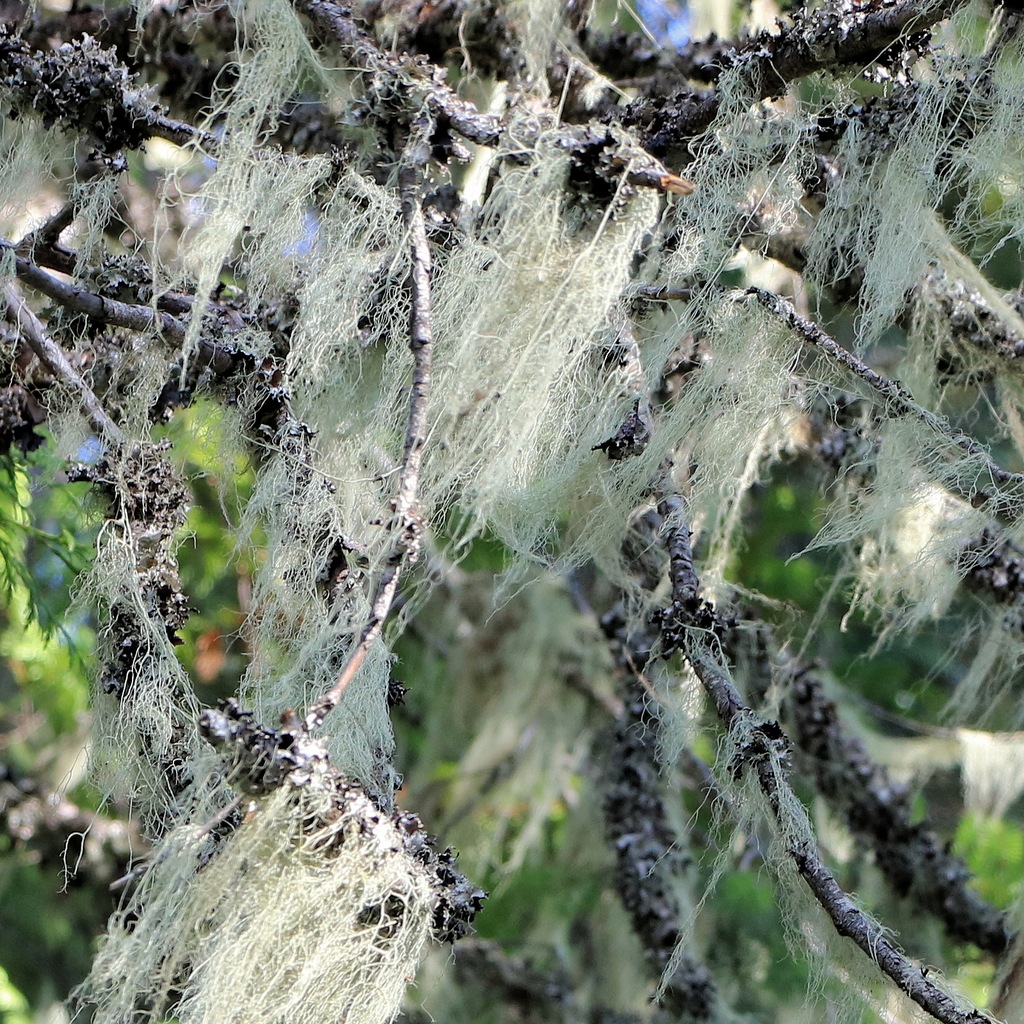
Usnea looks like something a tree grew after deciding it was old enough to stop shaving. Pale green tufts cling to branches, and longer strands hang in the breeze like a beard that has never met a comb. Once you start noticing it, a familiar walk becomes a different kind of search. You are looking above the wildflowers, along the bark, and into the small tangles that were easy to ignore when your attention was on the trail.
Commonly called old man’s beard, usnea has earned a place in conversations about survival skills, natural dyes, and traditional medicine. Some of those conversations are useful. Others race from “this contains an interesting compound” to “put it on everything” without stopping to check the evidence. There is plenty to appreciate here without making those leaps. Learning its structure, recognizing its lookalikes, and understanding a few practical uses will give you a much better relationship with this strange little forest resident.
First, That Beard Is a Lichen
Usnea is a genus of lichens rather than a single plant species. A lichen is a partnership involving a fungus and a photosynthetic partner, which in usnea is a green alga. The fungus provides much of the structure, while the alga uses light to produce food. Rocky Mountain National Park’s introduction to lichens explains this relationship and the remarkable variety of forms it produces. The pale tangle on a branch is therefore doing something considerably more interesting than looking like misplaced hair. Two very different kinds of organisms are making a living together.
You may hear usnea described as a fruticose lichen. That word refers to its branching, bushy or hanging form. It does not mean that it produces fruit you should collect for lunch. A small tuft can resemble a miniature leafless shrub, while a longer specimen may drape from its attachment point. Look closely and you will not find the leaves, flowers, and seedpods you would expect from a flowering plant. A hand lens makes the branching especially enjoyable to inspect, turning a vague green fuzz into something with a surprisingly elaborate structure.
What to Look For in Colorado
Colorado has several usnea species, and the name old man’s beard should not persuade you that every specimen must hang down to your knees. Local lichen observer Nick Moore describes small, shrubby forms on conifers as well as longer forms in adequately moist mountain settings in Colorado Lichens and Friends. A modest tuft on a fallen twig may be a more realistic introduction than the enormous curtains photographed in wetter forests. Slow down near conifer branches and examine the little growths as carefully as the dramatic ones.
The Rocky Mountain National Park lichen checklist records both Usnea cavernosa and Usnea lapponica. The Consortium of Lichen Herbaria’s account of U. lapponica describes a shrubby to partly hanging lichen found on bark, including conifers, with a mountain elevation range that includes roughly 9,500 feet. That supports looking for usnea in Colorado’s high forests, but it does not identify a particular tuft at our elevation. Moisture, the tree, and the lichen’s own features still have to enter the picture.
For this article, keeping the identification at Usnea is deliberate. Species identification can require close examination of surface structures, internal proportions, and chemical reactions interpreted through a proper key. There is no need to pretend that a photograph and a confident caption settle all of that. You can learn to recognize the genus while remaining honest about which species you have. Write “Usnea sp.” in your field notes when that is the level you can support, then keep the photographs that might help an experienced lichenologist take the identification further.
The Little Cord Inside the Branch
The characteristic worth learning is the tough, elastic central cord inside a usnea branch. On a tiny piece that you are permitted to handle, gently tease apart a reasonably substantial strand. The outer covering may separate while a thin pale cord remains between the pieces. Think of a little stretch of thread inside a green sleeve. Oregon State University’s lichen identification material uses this central cord to distinguish usnea from similar-looking Alectoria. It is a much stronger clue than “green and hanging from a tree.”
Use restraint with the demonstration. One small, naturally detached piece can teach the lesson without pulling a living tuft apart for every person in a group. A very dry, brittle specimen or an extremely fine tip may break before you expose anything useful. That is a reason to pause, inspect more carefully, and consult a key, rather than repeatedly shredding a handful. Check the overall branching form and its rounded strands alongside the internal structure. Finding the cord helps with identification, but it is not an edibility test, a measurement of medicinal strength, or permission to use the lichen on an injury.
Not Every Hanging Tangle Is Usnea
Alectoria, often called witch’s hair, can have a similar pale, hairlike appearance, but it lacks usnea’s distinct central cord. Evernia and Ramalina can also invite confusion at a glance, although their flatter branches offer a useful difference from the generally rounded usnea strands. The lesson is to examine structure instead of sorting every dangling growth by color. Light, moisture, and the background can change how a photograph looks, and several kinds of lichen may occupy the same tree. Trace the particular strand you are examining back into its own tuft.
Spanish moss adds another layer of confusion for anyone who has traveled through the Southeast. Despite its name, it is neither a moss nor a lichen. It is a flowering plant in the bromeliad family. The Missouri Department of Conservation’s beard lichen guide explains the resemblance and the distinction. Remember that when someone identifies something only as old man’s beard. Common names are helpful for conversation, but they can travel between unrelated organisms. Ask what the name refers to before carrying a use or identification tip from one region into another.
Is It Hurting the Tree?
A branch covered in lichen can look as though it has caught something, especially if the tree is already struggling. Usnea growing on bark uses the tree as a place to live rather than as a source of stolen sap. University of Maryland Extension explains that lichens grow harmlessly on tree surfaces and do not require removal. Finding a beard on an unhealthy branch does not establish the cause of that branch’s condition. Scraping off the lichen is therefore a poor response to a tree problem you have not actually diagnosed.
This makes a useful observation exercise. Compare a shaded branch with a nearby exposed one, then note where different lichens are growing. Record the tree, the light, and whether you are looking at a trunk, a fine twig, or older wood. Resist the urge to invent an explanation for every difference on the first walk. Those notes give you questions to investigate on later visits, and they help you see the forest as a collection of small living places rather than one uniform background.
A Small Role in the Fire Kit
Dry beard lichens have been used as tinder, a use documented by the Missouri Department of Conservation. Their fine branching structure is the attraction, but appearance alone does not tell you whether a particular tuft is dry enough to perform well. Material gathered after rain or from damp ground may be disappointing. Treat it as a possible ingredient in a tinder bundle, not a promise of instant fire. A survival kit still deserves dependable ignition tools and prepared tinder that you have actually practiced using.
If you want to experiment, do it before you are cold, wet, and counting on the result. Where collecting and fire are allowed, use only a small amount of abundant, already detached material in a controlled practice area. Have your fine kindling ready before lighting anything, and observe whether the lichen catches, how quickly it burns, and whether the next fuel takes over. The useful lesson is the transition between materials. A brief flame that dies while you search for twigs has taught you something, but it has not built the fire you needed.
Traditional Uses and an Important Medical Distinction
Usnea has a long history in herbal preparations, including external applications. One of its compounds, usnic acid, has shown antimicrobial activity in laboratory studies. The National Institutes of Health’s LiverTox account also documents serious liver injury associated with oral products containing usnic acid, including cases of liver failure. Much of that human evidence concerns concentrated supplements, often with multiple ingredients. It should not be misrepresented as proof that simply touching a lichen causes the same injury, but it is a strong reason not to turn an internet reputation into a homemade dose.
A laboratory result is not a field prescription. It does not establish that a tea, tincture, or handful of raw lichen will safely treat an infection. This is not a recommendation to ingest usnea, and there is no home extraction or dosing recipe here. Likewise, lichen taken from a branch is not sterile dressing material. Keep it out of open wounds and use appropriate first-aid supplies instead. Traditional use is worth studying, while decisions about treating illness belong with a qualified clinician who can consider the actual preparation and the person using it.
Dyes, Crafts, and a Better Reason to Carry a Hand Lens
The Forest Service’s guide to commercially important special forest products records usnea in decorative crafts and as a source of yellow dye, along with historical uses of its fibrous material. These records are interesting examples of people noticing useful properties in something easy to overlook. They are not instructions to gather a sack from the nearest tree. Dye projects can consume far more material than a simple identification exercise, and a slow-growing lichen deserves more thought than an abundant garden clipping.
For an easy project that leaves the lichen in place, photograph a tuft against a dark background, then make a close drawing of one branching section. Try to reproduce the pattern rather than drawing a general cloud of green. You will begin noticing where thick branches divide, where fine side branches emerge, and whether the surface looks smooth or textured. Children can compare the sketch with a photograph afterward, and adults may discover that drawing something is a very effective way to find out how little they actually looked at it.
The Forest Has Uses for It Too
Tree-dwelling lichens contribute to wildlife habitat, nesting material, and nutrient cycling. The Forest Service’s ecosystem indicator program includes these roles in its work on epiphytic lichens. There is also a very specific example from another region: Acadia National Park describes northern parula warblers weaving usnea strands into their nests. That does not mean the same bird is using the lichen beside your Colorado trail. It does show why material that looks unused to a passing hiker may already have a place in another animal’s life.
Lichens are also useful to scientists studying air pollution. They absorb substances across their surfaces, and different species respond differently to environmental conditions. Researchers examine communities and sometimes analyze their tissues rather than using one tuft as an all-purpose air-quality certificate. Seeing usnea can be an interesting observation, but it cannot prove that nearby water is safe to drink or that collected material is free from contamination. The scientific value comes from careful methods and context, the same habits that improve your own outdoor observations.
Leave the Tree Its Beard
Check collection rules before removing anything, even a fallen piece. When a small educational sample is permitted, favor naturally detached material and leave attached growth alone. Skip sparse patches, avoid breaking branches, and remember that something growing slowly cannot replace a careless handful as quickly as a weed in a garden. A photograph is often all you need. There is no requirement to carry a specimen home simply because you have finally learned its name, and there is plenty of satisfaction in returning to find it still growing where you first noticed it.
Usnea is a good reminder that outdoor knowledge does not always end with something edible or a dramatic survival trick. Sometimes it gives you a useful material to test, a claim to question, or a new reason to pay attention to a familiar tree. The next time you spot that pale beard, look at its branching, consider its surroundings, and take the time to identify it properly. That patient observation is part of the approach we practice at The Survival University. The woods become more interesting when you know what you are looking at.
Written by Jason Marsteiner, founder of The Survival University.
Photo credits: ImagePerson / Wikimedia Commons, branch photograph and detail photograph. Both are released under CC0 and cropped to 1024 × 1024 pixels. These genus reference photographs were taken near Revelstoke, British Columbia, not at our Colorado camp.
