


Image note: The three images in this article are AI-generated illustrations created to visualize the conditions discussed. They are not photographs of Bert Goris or his rescue.
When 64-year-old Bert Peter Goris died on Mount Katahdin in Maine, someone brought the story to my attention. At the time, I had so much on my plate that I never really sat down to look beyond the initial report and understand what had happened, but the story stuck with me. Since then, I’ve gone back through the reporting, looked more closely at the conditions and the terrain, and I think there are several lessons here that are getting overlooked.
Much of the coverage seemed to focus on the same takeaway. Sometimes you have to leave somebody behind in order to save yourself. The people who found him tried to help, the weather was getting worse, they were concerned about becoming hypothermic themselves, and eventually they had to continue down the mountain without him. I understand that argument. There absolutely can come a point where staying with somebody creates another victim instead of another rescuer. But if that is the only thing somebody takes away from this story, I think we are missing a huge part of it.
Before anybody starts sharpening their pitchfork, I was not there. I do not know the hikers who found him. I do not know what training they had, exactly what equipment they were carrying, what they tried that never made it into the news reports, or how cold and exhausted they were becoming themselves. I am not trying to blame the people who stopped to help, and I am definitely not sitting here pretending I know I could have changed the outcome. I am taking the information we do have and looking at it through the eyes of someone who teaches survival and has wilderness medical training. Use the information however you want.
What Was Reported on Mount Katahdin
According to Baxter State Park, Goris had summited Katahdin and was coming back down when the weather turned ugly. There was periodic rain, wind gusts over 35 mph, and a wind chill around 20 degrees. Another hiker saw him wearing wet shorts and a long sleeve shirt and encouraged him to put on more clothing. Not long afterward, he was found lying on the Hunt Trail near York Valley with what appeared to be a leg injury. He was having trouble speaking and could not move effectively.
The first hiker who called 911 wrapped him in a sleeping bag, emergency blanket, tarp, and tent. That hiker eventually had to head down because of the risk of becoming hypothermic too. Another hiker came across Goris later, added another sleeping bag, and eventually had to descend as well. Rangers and a National Guard helicopter eventually reached him, but he was pronounced dead after being flown off the mountain. As of the latest reporting I found, the medical examiner had not released the official cause of death, so I am not going to tell you for sure that hypothermia has been officially proven as the cause.
Recognizing a Serious Hypothermia Emergency
But look at what we know. He was wet. The wind was howling. The wind chill was around 20 degrees. He could not move effectively and he was having difficulty speaking. I think almost anybody looking at that situation is going to have hypothermia high on the list. What some people may not realize is how important those last two symptoms are. When somebody is losing the ability to move normally, think clearly, communicate normally, or take care of themselves, the situation has moved well beyond simply getting cold. In the field, wilderness medical guidelines actually use mental status and the ability to move as part of assessing how serious hypothermia may be when you cannot stick a thermometer into somebody and get a reliable core temperature.
At that point, I am not just thinking, “Let’s put another blanket on him.” I am thinking, “This guy needs to be rewarmed.” Those are signs that should make you start looking for serious ways to stop the heat loss and put heat back into him while you are waiting for rescue.
Insulation, Wet Clothing, and Rewarming
That distinction is important because insulation and rewarming are not the same thing. A sleeping bag, blanket, tarp, or extra clothing helps hold onto whatever heat the person is still producing. That is good, and you absolutely want to do it. But before you start piling insulation around somebody who is soaked, you also need to deal with the wet clothing. As soon as you can protect them from the weather while doing it, get the wet clothes off and replace them with something dry. Otherwise, you are wrapping insulation around a person who is still losing heat through evaporation. In mild hypothermia, somebody who is still shivering hard may be able to generate enough heat to warm themselves once you get them dry, fed, protected from the weather, and properly insulated. As hypothermia gets worse, their ability to do that drops. Eventually shivering becomes less effective and can stop altogether. At that point, wrapping somebody up without adding heat may slow down the problem, but it may not fix the problem.
Ground Insulation Is Part of Patient Care
Then there is the ground, which is something people overlook all the time. You can pile sleeping bags and blankets on top of somebody until they disappear underneath them, but if they are lying directly on cold rock, wet ground, or snow, they are still losing heat underneath themselves. That is conduction. Two things at different temperatures are touching, and heat moves from the warmer one into the colder one. In this case, the warmer thing is the human being and the colder thing is the mountain. If you do not put insulation underneath that patient, the ground keeps taking heat from them.
That means a sleeping pad becomes medical equipment. If you do not have one, start looking at what you do have. Another sleeping bag, dry clothing, backpacks, whatever insulating material you can realistically put underneath the person. A thin tarp can help keep moisture away, but a tarp by itself is not much insulation from frozen or wet ground. This is one of those little things that training teaches you to see differently. You stop looking at a backpack as just a backpack and start looking at it as something that might get six inches of insulation between a dying person and cold rock.
And I want to be clear about something here. I am not saying the people who stopped to help Goris failed to do these things. According to the reports, the first hiker who found him wrapped him in a sleeping bag, an emergency blanket, a tarp, and a tent, so he was clearly trying to protect him from the cold and weather. We do not know exactly how everything was arranged, what was underneath him, whether his wet clothing was removed, or what else may have been done that never made it into the reporting. I am not picking apart somebody else’s rescue attempt from behind a computer. I am passing along the things I would be thinking about in that situation because somebody reading this may someday find themselves trying to keep another person alive in the cold and may not know how many different ways that person is losing heat at the same time.
That is what makes a situation like this so difficult. The ground is pulling heat away through conduction. Wind keeps carrying warmed air away from the body. Wet clothing and evaporation are pulling away even more. So now you are trying to solve several problems at once. Protect him from the wind as much as the terrain allows. Get the wet clothing off and replace it with something dry. Keep additional moisture away. Insulate him underneath and around his body. Then start figuring out how you are going to actually put heat back into him.
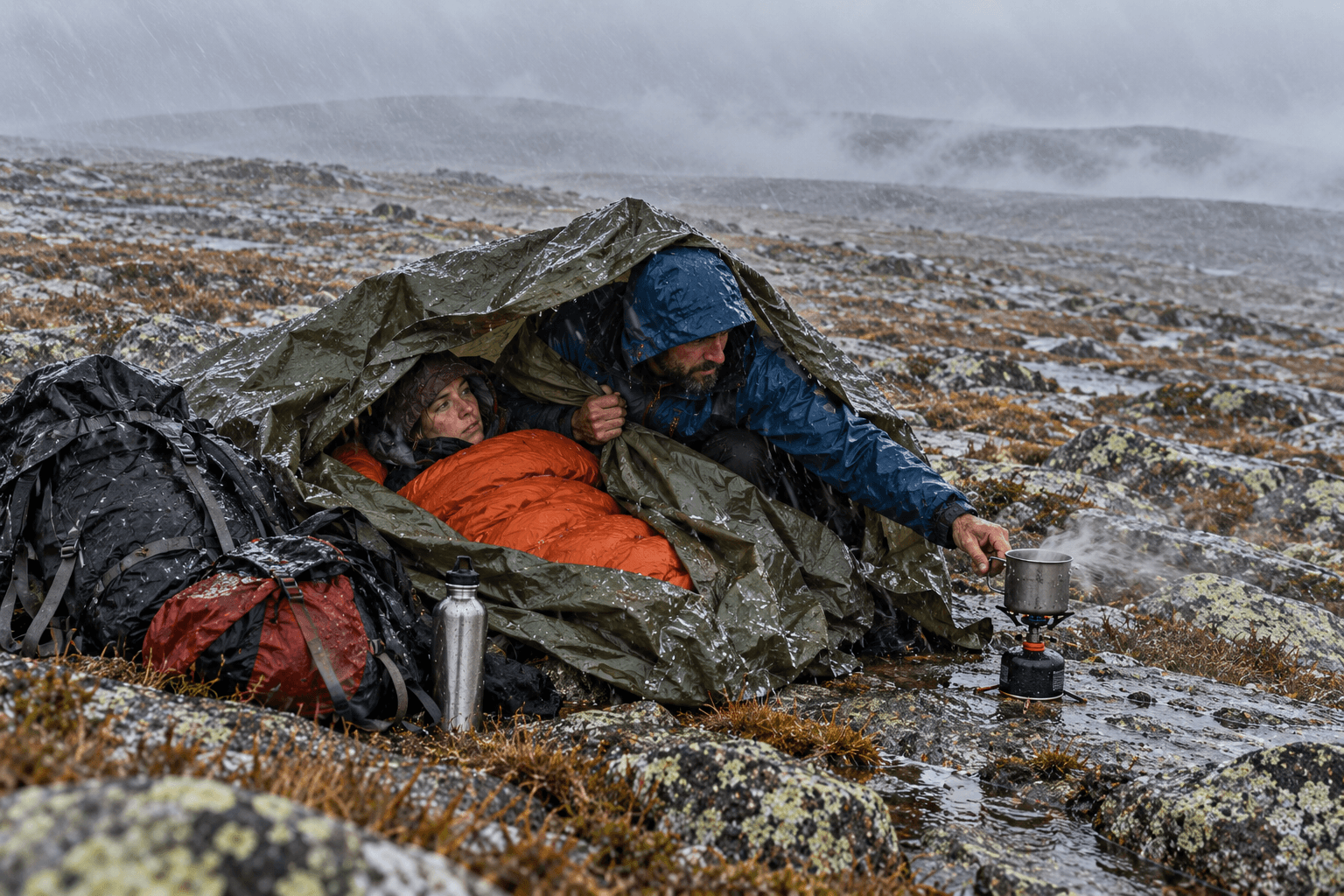
Improvised wind protection and rewarming in exposed mountain terrain. AI-generated illustration.
Adding Heat During a Wilderness Emergency
This is where an outside heat source becomes a very big deal. Wilderness medicine guidance recommends active heat for hypothermia and specifically discusses putting effective heat sources around the upper body, particularly the armpits, chest, and back. A sturdy, leakproof bottle that can safely hold hot water can become a very useful rewarming tool. I am not talking about a double-wall insulated bottle like a Hydro Flask or similar thermos-style bottle. Those are designed specifically to keep heat from escaping, which means very little of that heat is going to reach the patient. You want a container that safely holds hot water but still allows that heat to transfer through the bottle. That is one of the reasons I carry a single-wall metal water bottle. I can heat water, put it in the bottle, and use the bottle itself as a heat source if I need to. Wrap it in clothing or another layer so it cannot burn the skin, then place it against the upper torso where that heat can actually be transferred into the patient.
A larger medical warming pad can do the same thing. The heat source needs to be wrapped or otherwise kept from burning cold skin, because badly chilled skin can burn much easier than people realize. Little hand warmers are better than nothing for keeping your fingers working, but they do not put out enough heat to be relied on to rewarm somebody’s core.
If I have a stove, a pot, water, and a bottle that can safely handle hot water, suddenly those items are not just cooking gear anymore. I can make an outside heat source. That is the kind of thinking I want people to develop. You are not looking for one magical survival gadget. You are looking at everything you have and asking what problems you can solve with it.
Warm Drinks and Safe Swallowing
Warm drinks can help too, but there is a big qualifier. If somebody is awake, shivering, and swallowing normally, a warm sugary drink can give them calories to keep producing heat. The calories are actually more useful than the temperature of the drink itself. If somebody is significantly confused, barely responsive, or cannot swallow safely, do not start pouring hot chocolate into their mouth and create an airway problem on top of everything else.
When Body Heat Is the Only Available Heat Source
If body heat is the only heat source available, then use it. However, before I consider using my own body heat, the other protective measures need to be in place. Get him protected from the wind and rain. Once I can keep him sheltered, get him out of wet clothing, dry him, insulate him from the ground, and wrap him in dry insulation. You do not just climb into a sleeping bag with a cold, wet person and expect that to solve the problem. If I get myself and my insulation wet while we are both still exposed, I can put myself at risk of hypothermia too. I need to stay warm enough to keep helping him. If I have a better heat source available, I would use it safely on the upper body, with protection against burns. If my own body heat is all I have left, I would consider sharing it only after those protective measures are in place, provided I can stay warm and it does not delay rescue. With somebody already having trouble moving and speaking, I would not count on body heat alone to reverse the situation. I am looking for every practical way to stop further heat loss, add warmth, and get him help.
Wet Clothing and Paradoxical Undressing
There is another part of this story that caught my attention. He had been seen wearing wet shorts and a long-sleeved shirt in those conditions. And I have to admit, one of the first things that went through my head was, where were his pants? Did he start the day wearing more clothing? Did he have more clothing with him? We simply do not know. The reports I found do not say what he was wearing when he left camp that morning, so I am not going to invent an answer.
There is, however, a phenomenon associated with severe hypothermia called paradoxical undressing. In some cases, somebody who is dangerously hypothermic suddenly feels hot and starts removing clothing. Their judgment is already failing and changes in blood flow can create that sensation of warmth at exactly the wrong time. It has been documented in fatal hypothermia cases for decades. I want to be very clear that I am not saying that happened to Goris. We have absolutely no evidence that he removed clothing. But if you ever encounter somebody inadequately dressed in severe cold and behaving strangely, do not automatically assume they simply made a stupid clothing choice or are up to no good. Their brain may already be affected by the cold.
The Hunt Trail and Exposure Above Treeline
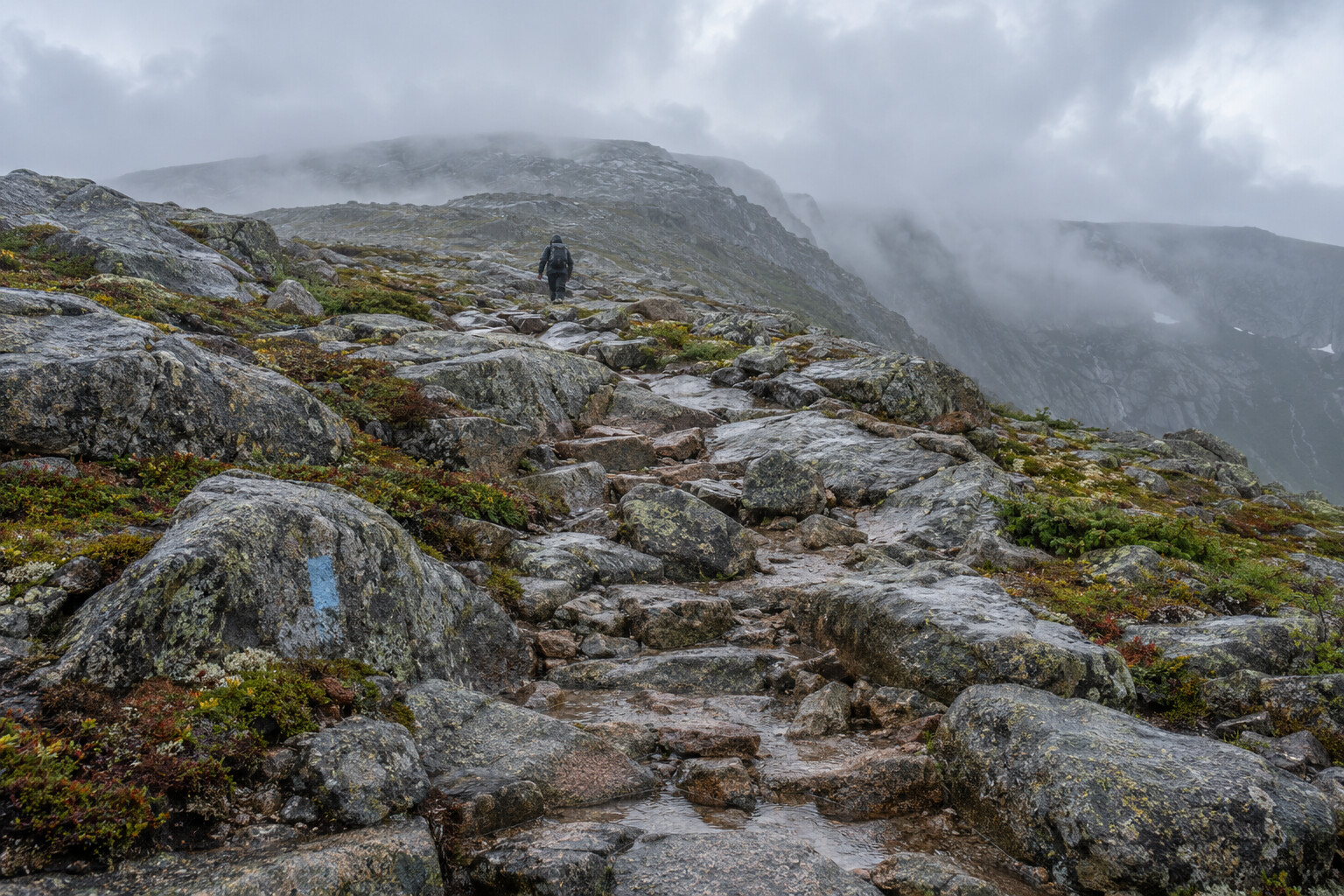
Being from Colorado, when I first read that this happened on a mountain trail, I pictured something more like the high alpine peaks I am used to in the Rockies. Then I went and actually looked at Katahdin and the Hunt Trail because I wanted to understand the terrain better. Katahdin may not have the elevation we associate with big mountains out West, but once you get above treeline, the problem becomes pretty obvious. The Hunt Trail is rated by Baxter State Park as very strenuous, gains more than 4,000 feet, and spends about 2.4 miles above treeline. Up there you are dealing with exposed rock, boulders, open terrain, and very little natural protection from the weather. There is no convenient stand of trees to duck into when the wind gets ugly and no pile of dry firewood waiting for you. Even moving over that terrain is difficult, which becomes a completely different problem once somebody is injured and can no longer keep themselves warm by walking. That should make people think a lot harder about what they carry above treeline or open terrain, because when the environment gives you almost nothing to work with, whatever is in your pack may be all you have.
That makes what you carry out there a lot more important. Down in the trees I may have wood, natural wind protection, and the ability to build a fire. Above treeline, you have none of that. If your entire warming plan is “I’ll build a fire,” and there is not a stick of usable wood anywhere around you, you do not have a warming plan. This is why people who spend serious time in alpine and winter environments carry things like emergency shelters, insulating pads, dry clothing, additional insulation, stoves, fuel, and equipment that still gives them options when the environment gives them absolutely nothing.
Weather Decisions Begin Before the Trailhead
But looking at the terrain brought up another part of this incident that I think deserves just as much attention as what happened after Goris was found. What were the conditions supposed to be before everybody went up there? The National Weather Service had issued a summit forecast at 2:44 that morning calling for temperatures in the mid-40s, scattered showers, and northwest winds of 25 to 40 mph. The forecast literally described the summit as “very windy.” The previous afternoon’s forecast was already calling for scattered showers, temperatures in the mid-40s, and winds of 25 to 35 mph for Monday. This was not weather information that became available only after people were already stranded on the mountain.
Wind Chill, Wet Clothing, and Heat Loss
And this is probably a good place to talk about wind chill, because I do not think everybody really understands what wind does to you. At 40 degrees with a 25 mph wind, the wind chill is about 29 degrees. That does not mean the actual air temperature suddenly dropped to 29. It means your body is losing heat at about the same rate it would in calmer air at that lower temperature. I am probably a little more aware of this than some people because I have been outside in temperatures around 20 below zero with winds around 45 mph. That gives you a wind chill of about 58 below. You do not stand around in that for very long before you become extremely aware of what wind does to the human body.
Now add being wet. Wind chill calculations do not even account for soaked clothing or rain. Wet clothing strips away insulation, evaporation pulls additional heat from the body, and the wind keeps carrying that heat away. So when somebody hears that the temperature was in the 40s, it may not sound particularly dangerous. But put that person on an exposed mountain, soak their clothing, add 25 to 40 mph winds, and then take away their ability to keep moving and producing heat, and that situation changes very quickly. That is why looking only at the temperature can give you a completely false sense of how serious the conditions actually are.
Preparing for the Moment You Cannot Walk
That does not mean nobody should ever hike a mountain when the weather is ugly. Somebody with the right experience, clothing, equipment, and judgment may be perfectly capable of operating in conditions that somebody else has no business being in. But that decision needs to happen before you leave the trailhead. If the forecast is calling for rain, temperatures in the 40s, and 25 to 40 mph winds on an exposed mountain, I need to be asking myself what happens if I suddenly cannot walk. Do I have enough clothing to stay warm when I stop generating heat? Can I get out of the wind? Can I keep myself dry? Can I survive sitting on cold rock for several hours while somebody comes to get me? If the answer is no, maybe today is not the day to climb the mountain.
And that applies to the other hikers too. Much of the conversation around this story has centered on whether the people who found Goris eventually had to leave so they would not become victims themselves. Fair enough. But wilderness survival does not begin when you discover the injured guy lying on the trail. It began when you checked the forecast that morning. It began when you decided what went into your pack. It began when you looked at the terrain, looked at the weather, and decided whether you were prepared to deal with what would happen if the hike suddenly stopped being a hike.
That does not mean I am blaming the people who went up the mountain that day. We do know at least some of what the rescuers were carrying. The first hiker reportedly had a tent, sleeping bag, and emergency blanket, and the second hiker had another sleeping bag. So clearly these were not people who walked onto the mountain with absolutely nothing. What we do not know is the rest of their gear, how prepared they were for a prolonged emergency in those conditions, or what decisions they made before heading up. My point is that the lesson from this incident goes much farther than, “Sometimes you have to leave somebody behind.” Sometimes the best survival decision happens before there is anything to survive. Sometimes it is adding another layer to your pack. Sometimes it is carrying a stove and shelter because you know there is nothing above treeline to work with. Sometimes it is turning around. And sometimes it is standing at the trailhead, looking at the forecast, and deciding you can climb the mountain another day.
What “Everything I Could” Means
And this is really where I get back to the part of the story that bothered me. Yes, there can come a time when you have to leave somebody behind. If you have tried everything you realistically can and staying is now putting your own life in serious danger, I understand making that decision. I would struggle tremendously with it, but I understand it. What I think deserves more discussion is what “everything I could” actually means, and I think that question starts long before the moment somebody is lying helpless on the ground.
If somebody has no survival training and no wilderness medical training, everything they know how to do may be pretty limited. They call 911. They cover the person up. They try to keep them comfortable. They wait for help until they start getting dangerously cold themselves. At that point, they may honestly believe they have exhausted every option because they have exhausted every option they know about. I am not making fun of that person. You cannot use a skill you have never learned.
How Wilderness Medical Training Expands Your Options
Give that exact same person good training and suddenly “everything I could” becomes much bigger. Now they are thinking about the ground underneath the patient. They are thinking about wind, wet clothing, evaporation, and shelter. They know the difference between trapping heat and adding heat. They know where to put an external heat source and where not to put one. They know whether that person should be drinking something or absolutely should not be. They know not to stand a significantly hypothermic patient up and start marching them around because movement itself can create problems as hypothermia becomes more serious. They know how to communicate useful information to rescuers, and they are also paying attention to their own condition so they do not become the next patient.
Good training should also change what happens before the emergency. It should make you pay closer attention to the weather. It should make you look at a mile of exposed rock very differently than a mile through the trees. It should make you understand that there is a huge difference between staying warm while climbing uphill and staying warm after a broken ankle puts you flat on your back. It should give you the discipline to turn around when the conditions have changed, and occasionally the discipline not to start in the first place.
Training Has Limits
None of that means training turns you into Superman. It does not mean you save everybody. It does not mean that anything I just described would have saved Bert Goris, because we simply do not know that. His injury could have been worse than reported. Another medical problem could have been involved. He may already have been too far gone. The people who found him may have done things that never appeared in any article. There are too many things we do not know for me to sit here and pass judgment on individual people.
What I can say is that training changes the number of options you have before you reach the point where you have nothing left to offer. It changes what you carry, what you notice, how you react when something goes wrong, and hopefully some of the decisions you make before anything goes wrong in the first place. That is why I teach this stuff, and it is why I think wilderness medical and survival training are so valuable for anybody who spends serious time in remote places. You are never going to know everything and you are never going to carry everything, but knowing how cold actually kills somebody, knowing what you can realistically do about it, and recognizing when the environment is stacking the deck against you gives you a much larger toolbox when somebody’s life depends on what happens next.
There may still come a day when you have done everything you safely can and you have nothing left to give. But “everything I could” is not a fixed amount. Training expands it. Knowledge expands it. Experience expands it. The more you know, the more options you have before you reach that point. You may not be able to save everybody, but training can make “everything I could” mean a whole lot more than it did before.
Learning From the Decisions Before the Rescue
I am sorry this turned into such a long article. Or maybe I am not. I just could not look at this incident, regurgitate the same “sometimes you have to leave somebody behind to save yourself” line that so many seem to be repeating, and leave it at that. There are bigger lessons here. There are lessons about weather, clothing, terrain, gear, hypothermia, training, decision-making, and what happens when somebody suddenly stops being able to move under their own power. The decision to leave somebody behind may have been the last decision in this story, but there were a whole lot of decisions before that one that are worth learning from too.
None of that changes the fact that a man died on that mountain. My condolences go out to Bert Goris’s family, friends, and everyone who cared about him. I also have a lot of respect for the people who stopped and tried to help him in absolutely miserable conditions. I hope nobody reads this as me trying to second-guess their intentions or diminish what they did. My reason for writing all of this is much simpler than that. If there is something we can learn from what happened, then I think we owe it to the next person who finds themselves cold, injured, wet, and a long way from help to actually learn it.
What to Do for Suspected Hypothermia
- Call for rescue early.
- Handle the person gently and keep them lying down.
- Protect them from wind and rain.
- Once sheltered, remove wet clothing and dry them.
- Insulate them from the ground.
- Wrap them in dry insulation, including the head and neck. Keep the face clear.
- Apply wrapped heat sources to the chest, armpits, and upper back. Check the skin for burns.
- Offer warm, sugary drinks only if they are fully alert and can swallow safely.
- Keep yourself warm and dry. Shared body heat is a limited backup after protection is in place, and must not delay rescue.
- Monitor breathing and responsiveness until help arrives.
About the Author
Jason Marsteiner is the founder and lead instructor at The Survival University and the author of Wilderness Survival Guide: Practical Skills for the Outdoor Adventurer. Raised in Colorado, he teaches practical survival skills and backcountry decision making to help people prepare for situations where help may be hours away.
