


March 14, 2026
What To Do If You Get Lost in the Woods
If you realize you may be lost while hiking, the most important thing to do is slow down and avoid making the situation worse. Stop moving, take a few minutes to calm yourself, and begin assessing your surroundings before you make any decision. Look for recognizable terrain features, think back to the last place you were completely certain of your location, and check any navigation tools you are carrying.
One rule that many people forget in this moment is to stay with your gear. No matter how tired, frustrated, or curious you are, do not separate yourself from the equipment you brought into the field. People sometimes drop their pack next to what looks like a very distinctive tree or rock so they can scout ahead or climb up onto a ridge to look around. A few minutes later they realize that landmark was not as unique as it seemed. When they try to return, the spot is much harder to find than expected, and now they are standing in the woods without their pack, water, fire starter, extra clothing, or navigation tools. A situation that was manageable just became much more serious.
In many situations, people get into deeper trouble because they keep walking while confused instead of pausing long enough to regain control of the situation. If you can confidently retrace your steps and the terrain is safe, backtracking may solve the problem quickly. If not, take more time to observe, think, and make a deliberate plan before acting. And whatever decision you make, stay with your gear.
That Moment When Something Feels Off
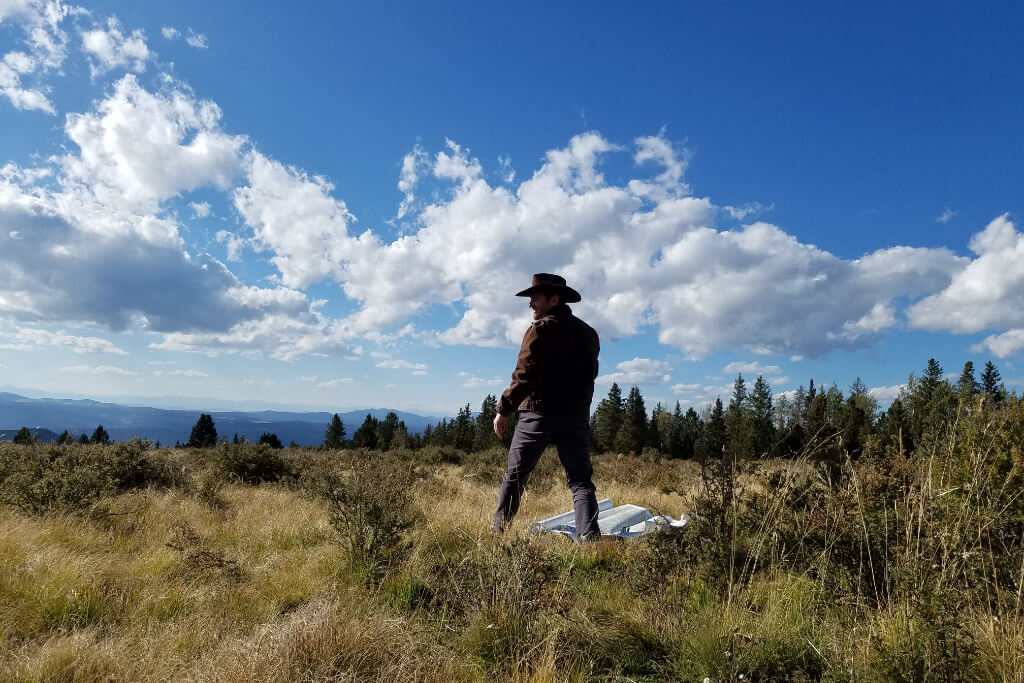
Most people do not realize they are lost all at once. It usually begins with a small feeling that something is not quite right. The terrain looks a little different than you expected. The trail that seemed obvious a few minutes earlier fades into rocks, grass, or scattered trees. You turn around to look behind you and the back trail does not look the same as it did when you were walking forward. Landmarks that felt familiar suddenly feel uncertain.
At this point many people reach for their phone, hoping to confirm their location. Sometimes the map loads. Sometimes it does not. In many places the signal is weak or nonexistent, and the technology people rely on every day suddenly becomes unreliable.
This is the moment when your brain begins working in two different directions. One part of you is trying to stay calm and think logically about where you are and how you got there. The other part begins to wonder if you may actually be lost.
That moment matters far more than most people realize. Many wilderness survival situations do not begin with a dramatic accident or sudden crisis. They begin quietly, when someone realizes they are no longer completely sure of their location. It is a small shift from confidence to uncertainty, and what happens next often determines whether the situation stays manageable or slowly becomes something much more serious.
The next ten minutes often determine whether the situation resolves quickly or slowly turns into a much larger problem. People who pause, slow down, and think carefully often resolve the situation quickly. Those who ignore the uncertainty and keep moving tend to make the problem worse without realizing it.
Why the First 10 Minutes After Getting Lost Matter Most
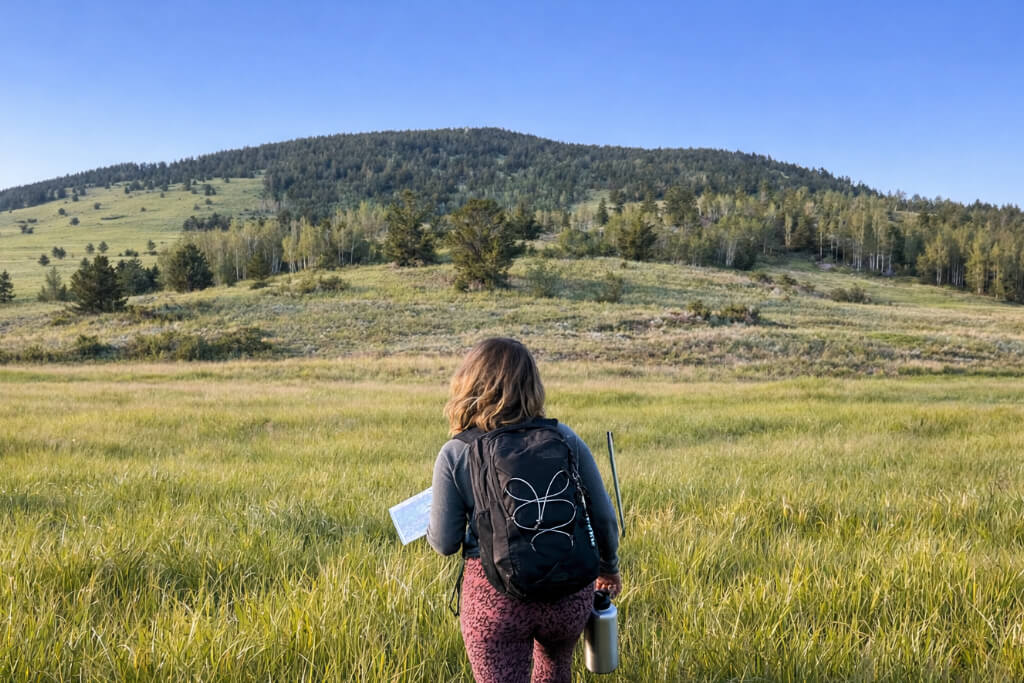
When people begin to suspect they might be lost, their instinct is almost always the same. They keep walking. Movement feels like progress, and stopping can feel uncomfortable or even embarrassing. Many people convince themselves that if they just continue a little farther the trail will appear again, a familiar landmark will come into view, or the terrain will suddenly make sense.
Situations like this are becoming more common as more people head into the outdoors with very little preparation, something I discuss in Americans Are Heading Out Into the Wilderness Unprepared.
The problem is that movement without clear direction rarely solves the situation. In fact, it often makes it worse. When someone continues hiking while uncertain about their location, they are no longer following a trail or a plan. They are simply guessing. Each step taken in the wrong direction increases the distance from the point where the original mistake occurred, and the terrain becomes more unfamiliar with every minute that passes.
Search and rescue teams see this pattern repeatedly. A hiker loses the trail, assumes it will reconnect farther ahead, and keeps moving. As the terrain becomes more confusing, they try another direction, then another, gradually drifting farther from the trail system they started on. What began as a small navigation error can quickly turn into miles of unintended travel.
This is why the first ten minutes after realizing you might be lost are so important. Those minutes create a natural pause where a person can slow down, reassess the situation, and make a deliberate decision instead of reacting on instinct. Taking control of that moment often determines whether the situation remains a manageable navigation problem or grows into something far more complicated.
Decision making problems like this rarely begin at the moment things go wrong. They usually start earlier with small breakdowns in communication, awareness, or leadership within the group, something I explore in Why Hiking Groups Fail Long Before Something Goes Wrong.
The S.T.O.P. Principle and the Idea of S.T.O.P.A.
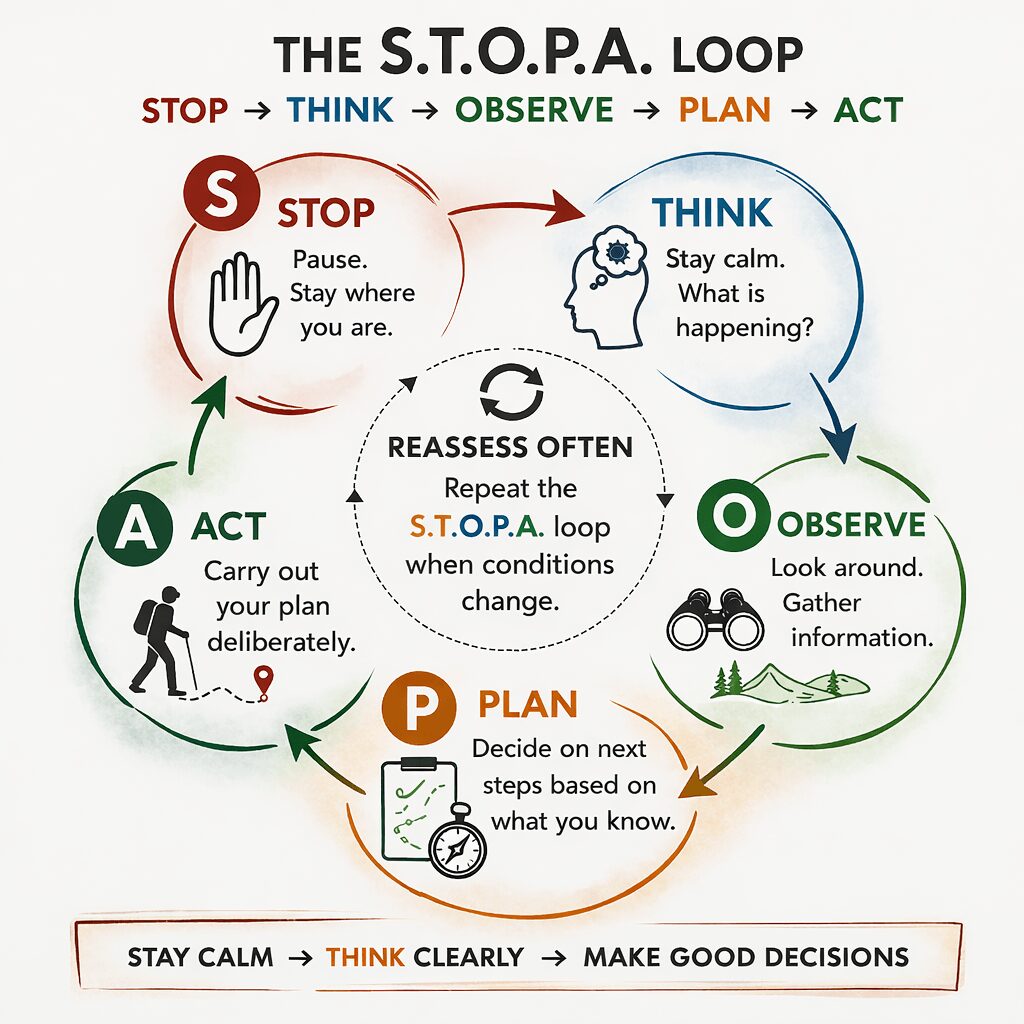
Before getting into the specific steps you should take during those first ten minutes, it is worth mentioning a concept that is widely taught in survival and outdoor training programs. Many instructors teach a simple framework called S.T.O.P. to help people regain control of a situation when something starts to go wrong.
S.T.O.P. stands for Stop, Think, Observe, and Plan. It is designed to interrupt panic and force a person to slow down long enough to understand what is actually happening around them. When people become lost or uncertain in the wilderness, their first instinct is often to keep moving and hope the problem resolves itself. The S.T.O.P. principle does the opposite. It reminds you to pause, assess the situation carefully, and make a deliberate decision instead of reacting on instinct.
It is a simple concept, and its simplicity is exactly what makes it effective. In stressful situations the brain does not process complicated instructions very well. A short framework that is easy to remember can help someone regain focus when they need it most.
Some instructors, like me, expand this idea slightly by adding one more step at the end, creating S.T.O.P.A. The additional letter stands for Act. After stopping, thinking, observing, and making a plan, you eventually need to carry that plan out in a controlled and deliberate way. The goal is not just to think about the problem but to take purposeful action based on the information you have gathered. You also do not want to freeze up and get stuck in the S.T.O.P. loop without actually doing something.
One of the most important things to understand about this process is that it is not something you use only once. Outdoor situations change constantly. Conditions shift, new information appears, and plans sometimes need to be adjusted. Each time something changes significantly, it can be useful to run through the S.T.O.P.A. process again.
For example, imagine you realize you may be lost and decide the safest choice is to stop moving and set up a temporary camp while you reassess the situation. That is your plan, and the Act step is carrying it out. Later in the evening, a severe storm moves in and the weather changes dramatically. Wind, lightning, or rising water may suddenly create new risks that were not present before. At that point the situation has changed, and it makes sense to go through the process again. Stop, think about the new conditions, observe what is happening around you, form a new plan, and act accordingly.
The same approach applies to many situations outdoors. A sudden drop in temperature, incoming flood water, increasing wind, or unstable terrain can all introduce new hazards that require reassessment. Running through the S.T.O.P.A. framework again helps you stay deliberate and prevents panic-driven decisions.
The steps that follow in this article expand on that same idea. The first ten minutes after realizing you might be lost are essentially a practical example of the S.T.O.P.A. process in action. By slowing down, observing the terrain, and making careful decisions, you give yourself the best chance of correcting a small mistake before it turns into a much larger problem.
Step One: Stop Moving Immediately
The first thing to do if you realize you might be lost in the woods is surprisingly simple. Stop moving.
This runs directly against most people’s instincts. When uncertainty creeps in, the natural reaction is to keep walking and hope you suddenly appear where you want to be. People tell themselves the trail must reconnect just ahead, or that if they push a little farther they will recognize something familiar. Unfortunately, continuing to move without knowing where you are usually spreads the problem instead of solving it.
Stopping gives you a chance to interrupt that cycle. When you pause, you prevent yourself from drifting farther away from the last place you were certain of your location. Even a few minutes of wandering in the wrong direction can make it much harder to retrace your steps later.
Take a moment to stand still and slow your breathing. Adrenaline and stress can narrow your attention and make it harder to think clearly. A calm mind is far more useful than rushing forward with a vague hope that the trail will reappear.
Stopping may feel counterintuitive at first, but it is one of the most effective ways to keep a small navigation mistake from turning into a much bigger situation.
Cold exposure can make that kind of clear thinking much harder than people expect, something I explain in How Hypothermia Changes Your Thinking.
Step Two: Look Around Carefully
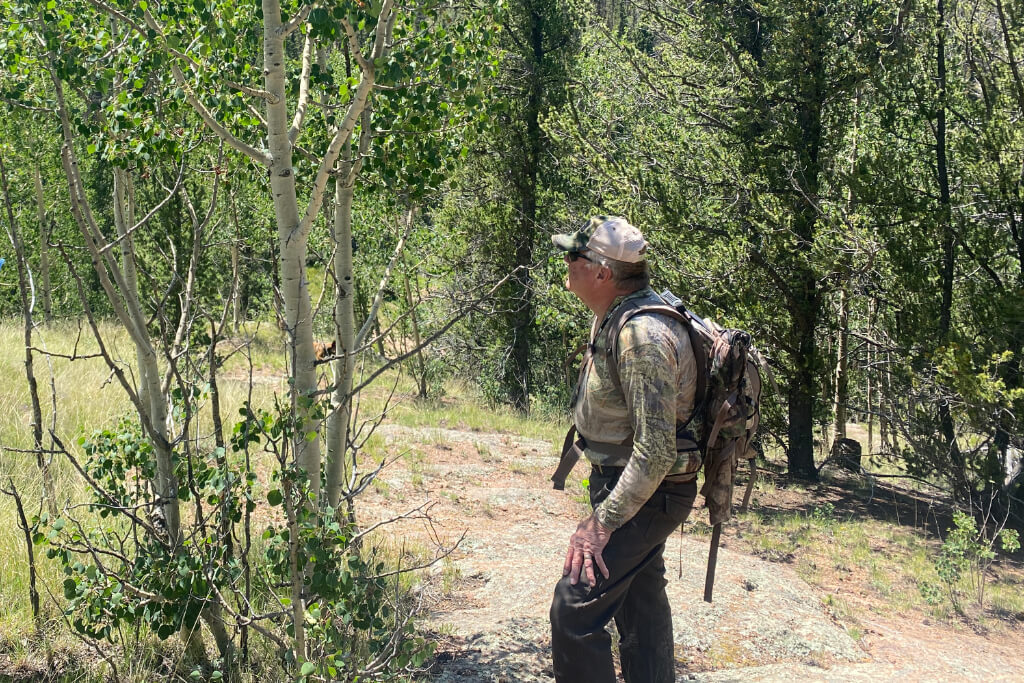
Once you have stopped moving, take a careful look at the area around you. This is not something to rush. People often glance around for a few seconds, do not immediately recognize anything, and then go right back to moving. That is usually a mistake. Slow yourself down and actually study the landscape.
Start noticing details that may help you reorient. Look for terrain features such as ridgelines, valleys, creeks, drainages, rock outcrops, open meadows, or any other features that stand out. These are often much more useful than focusing on random trees or brush, which can all start to look the same when you are stressed. If you have been paying attention as you traveled, there may be something familiar nearby that helps you connect your current location to where you were earlier.
Pay attention to the position of the sun as well. Try to remember where it was earlier when you were confident about your direction of travel and how the shadows were falling around you. Even a rough memory of whether the sun was in front of you, behind you, or off to one side can help you regain a general sense of direction.
It is also worth remembering that the trail may not truly be gone. In many situations it is still there, but it has become harder to see because of snow, grass, leaves, poor light, game trails, or a subtle change in terrain. People often assume they have completely lost the trail when in reality they have only stepped off it a short distance.
One of the simplest and most overlooked things you can do is turn around and look behind you. The route you came from often looks completely different in reverse. A section of trail that was obvious while moving in one direction may be much harder to recognize from the other, and the opposite can also be true. Sometimes just stopping and viewing the terrain from both directions is enough to make the situation clearer.
Learning to read terrain like this is a core navigation skill, something I explore more deeply in Navigation Unleashed: Maps, Compasses, and Wild Adventure.
Step Three: Think About Your Last Known Location
After you have taken a moment to stop and observe your surroundings, the next step is to think back to the last place where you were completely confident about your location. In navigation this is often referred to as your last known position and it can be one of the most useful pieces of information you have when trying to recover from a mistake.
Take a few moments to mentally retrace your steps. Think about where the trail was clear and obvious. Try to remember the last place where you saw a trail marker, a junction, or a recognizable landmark. It might have been a creek crossing, a ridgeline, a bend in the trail, or a section of terrain that stood out for some reason. These features often serve as anchor points that help you reconstruct the route you traveled.
It can also help to estimate how long ago you passed that location. If you remember crossing a stream ten minutes earlier, that gives you a rough sense of how far you may have traveled since then. Combining that memory with the direction you were moving can help narrow down where you might be in relation to the trail.
This kind of mental rewind is often enough to reveal where things started to go wrong. Many navigation mistakes happen when someone follows a faint path, misses a turn, or gradually drifts away from the main trail without realizing it. By identifying the last place where you were certain of your position, you give yourself a clear reference point for deciding what to do next.
Step Four: Check Your Navigation Tools
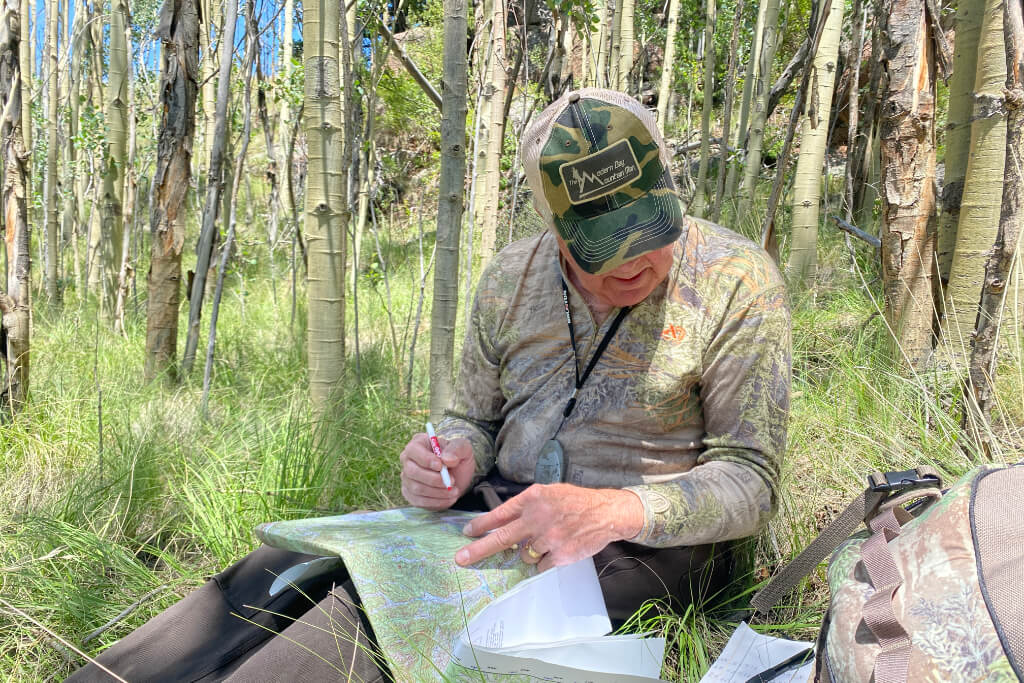
Once you have taken a moment to slow down, observe the terrain, and think about your last known location, it is time to check the tools you have with you. Navigation tools can be extremely helpful when used correctly, especially if you combine them with what you are already seeing around you.
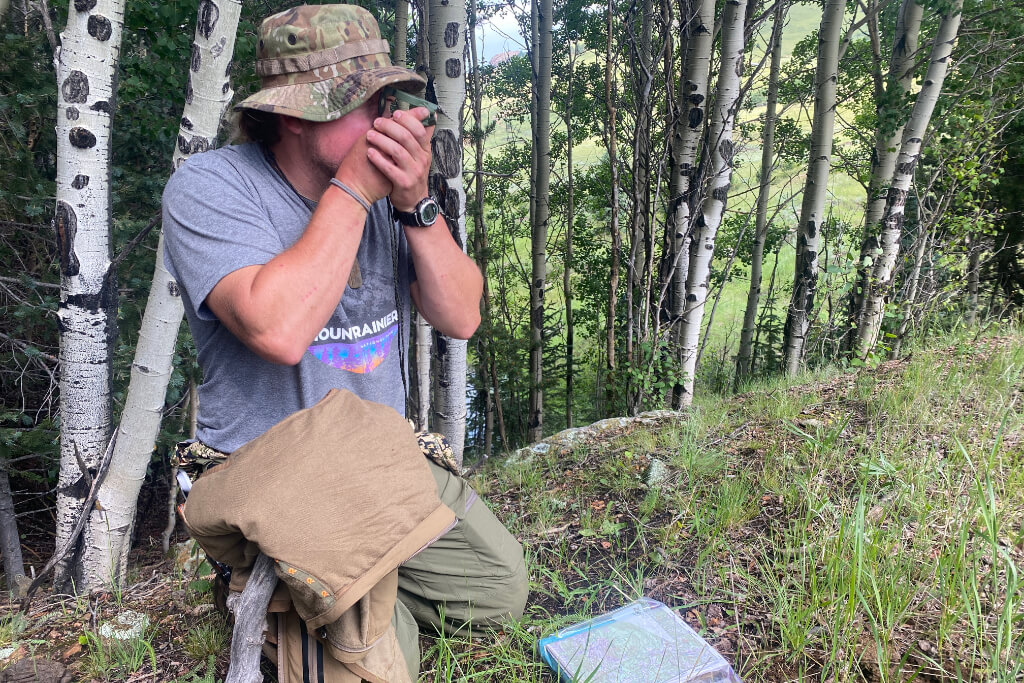
If you are carrying a map and compass, take them out and start comparing the terrain features on the map with the landscape around you. Look for large features that are easy to recognize such as ridges, drainages, valleys, cliffs, lakes, or prominent peaks. These features tend to appear clearly on maps and can help you orient yourself quickly if you are paying attention to the broader shape of the land.
If you are carrying a GPS unit or a phone with an offline map, this is also a good time to check it. Many mapping applications allow you to see your current position relative to nearby trails, roads, or landmarks, and they can quickly confirm where you are and how far you may have drifted from the trail.
It may sound obvious, but people often forget to use the tools they have when stress and uncertainty set in. Panic narrows attention. Instead of calmly checking their map or GPS, people sometimes start walking in the direction that simply feels right. Slowing down long enough to check your tools can often clear up the situation quickly.
At the same time, it is important not to rely entirely on technology. Batteries run out. Phones lose signal or shut down in cold conditions. GPS units can struggle under heavy tree cover or steep terrain. Navigation tools should support your awareness of the landscape, not replace it. The best results usually come from combining your tools with careful observation of the terrain around you.
Learning to use these tools properly is part of developing real navigation ability, something I discuss in more detail in Navigation Skills vs Orienteering and Geocaching: Why Real World Navigation Matters.
Step Five: Make a Calm, Deliberate Decision
After you have stopped, looked carefully at your surroundings, thought about your last known location, and checked your navigation tools, you are finally in a position to make a decision. The goal at this stage is not to do something quickly. The goal is to do something thoughtfully.
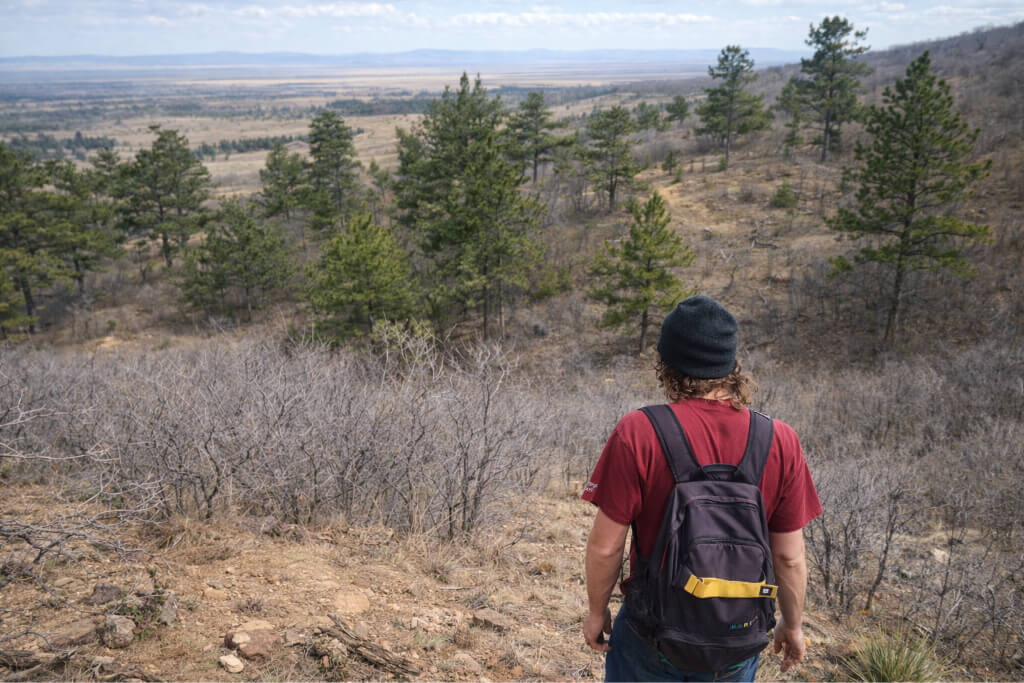
In many cases, the best option is to backtrack. If you have a clear sense of the direction you came from and the terrain is safe to move through, retracing your steps can often take you back to the trail, the last junction, or another point you recognize. This works especially well when you catch the mistake early and have not traveled very far off course.
This is also where a highly underrated skill becomes extremely valuable. If you know how to track, you can often track yourself back out of a bad situation. Your own footprints, broken vegetation, disturbed soil, or displaced rocks can create a trail that leads you back to where you came from. Many people think of tracking only as something used to find animals or how SAR teams find other people, but the same skill can help you follow your own sign and recover from a navigation mistake. This is one of the reasons we teach Search and Rescue Tracking to everyday hikers in our training programs. Learning how to read sign on the ground gives you another tool for finding your way when the trail disappears.
In other situations, moving immediately may not be the best choice. If the terrain around you is confusing, steep, thick, or unfamiliar, pushing ahead without confidence can make the problem worse. Sometimes the smarter decision is to stay where you are for a little longer, continue assessing the area, and avoid making a rushed move based on guesswork.
What matters most is that your decision is calm and deliberate. People often get into deeper trouble because they feel pressured to act right away, even when they are still uncertain. A careful decision made with a clear head is almost always better than a fast decision driven by frustration, embarrassment, or panic.
The First Things To Do If You Get Lost While Hiking
- Stop moving and control panic
- Look carefully at the terrain around you
- Think about your last known location
- Check your map, compass, or GPS
- Make a calm decision before moving
- Act deliberately on that decision
The Biggest Mistake People Make When They Get Lost
The biggest mistake people make after realizing they might be lost is continuing to move without knowing where they are going. Every step taken in uncertainty increases the distance from the last place where they were confident about their location.
This has a major impact on what happens next if the situation escalates. Search and rescue teams begin their work using the last known position as a starting point. When someone keeps moving while unsure of their direction, the potential search area grows larger with every hour.
A person who was only a short distance off the trail can end up miles away simply because they kept walking while trying to figure things out. By the time help becomes involved, the individual may be far outside the area where rescuers would normally expect to find them.
In many cases the original mistake was small. The real problem was continuing to move instead of stopping long enough to regain control of the situation.
How to Avoid Getting Lost in the First Place
The most effective way to deal with getting lost is to prevent the situation from happening at all. Good navigation habits dramatically reduce the chances of losing the trail or drifting into unfamiliar terrain, and most of those habits are surprisingly simple. They come down to paying attention.
Many people hike for miles while focusing almost entirely on the trail directly in front of their feet. While that keeps you from tripping over rocks and roots, it does very little to help you understand where you are in the landscape. A better approach is to regularly look up and observe the broader terrain around you. Notice ridgelines, valleys, water features, and distinctive landmarks. Pay attention to trail junctions and changes in direction. These details create a mental picture of the area that can help you stay oriented as you travel.
This idea is closely related to something I call Lost Proofing: The Mindset that Brings you Home, which focuses on developing awareness habits that keep small navigation mistakes from turning into larger problems in the first place.
It also helps to periodically check your map, even when you believe you know exactly where you are. Confirming your position from time to time keeps you connected to the bigger picture of the route and makes it much easier to catch small navigation mistakes early. Waiting until you are already confused before looking at the map is far less effective.
Many experienced hikers follow a simple rule that helps prevent small errors from becoming larger problems. If something about the terrain suddenly feels wrong, stop immediately and figure out why before continuing. That feeling of uncertainty is often an early warning sign that something has changed. Addressing it right away is far easier than trying to solve the problem after you have already traveled farther in the wrong direction.
Developing those habits takes practice. This is exactly the kind of skill we focus on during our Land Navigation courses, where students learn how to read terrain, use maps and compasses, and stay oriented even when trails disappear.
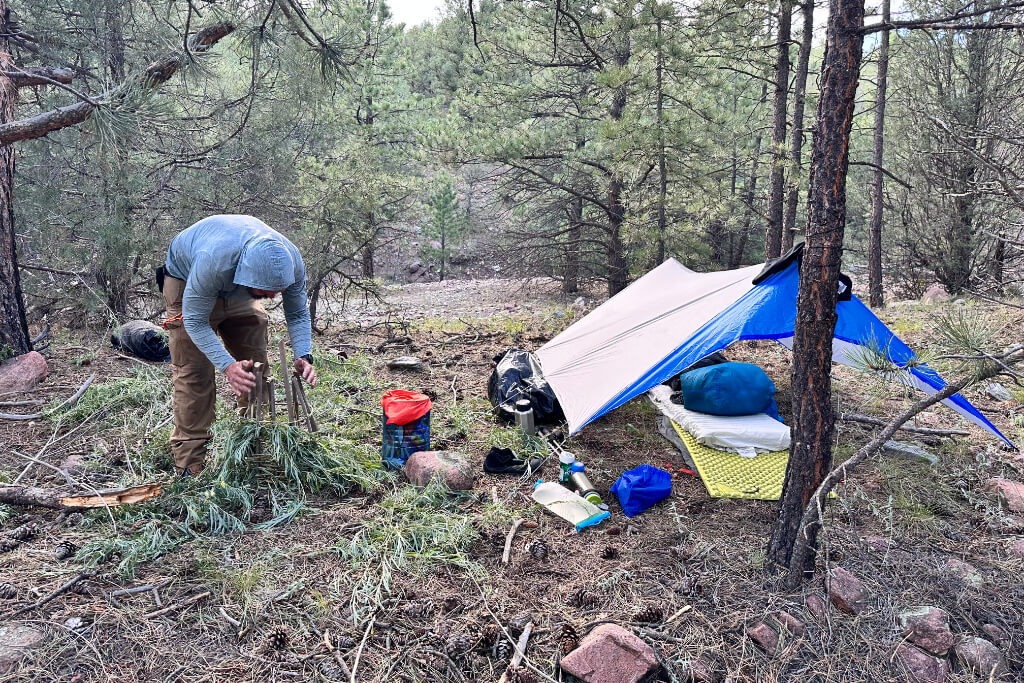
Learning to run through the S.T.O.P.A. process calmly is one thing. Being comfortable with the skills that might follow is another. Sometimes the safest decision after stopping, thinking, observing, and planning is to stay put and spend the night rather than wandering through unfamiliar terrain. Knowing how to build a shelter, manage fire, stay warm, and take care of yourself changes that situation from a stressful emergency into a manageable problem. These are the kinds of practical skills we focus on in our Outdoor Survival Basics courses, where students learn how to stay safe and functional if circumstances force them to stop and spend the night in the field.
Staying Found Is About Awareness
Getting lost in the wilderness rarely begins with a dramatic mistake. Most of the time it starts with something much smaller. A trail becomes faint or disappears for a short distance. A turn is missed at a junction. The terrain begins to look slightly different than expected, but the person continues walking anyway, assuming everything will make sense again in a few minutes.
Those small moments of uncertainty are often the first warning signs that something is off. The problem is that people tend to dismiss them. Instead of stopping to reassess their location, they keep moving in the hope that the trail will reappear or the terrain will become familiar again. In many cases that decision quietly compounds the problem, allowing a small navigation mistake to grow into something much more complicated.
The people who consistently avoid getting lost are not necessarily the strongest hikers or the most experienced outdoorsmen. More often they are the ones who pay close attention to their surroundings and take those early warning signs seriously. When something does not feel right, they pause long enough to understand why before continuing.
Spending time outdoors does not automatically translate into sound decision making when things start to go wrong, something I talk about in The Myth of the “Avid Outdoorsman.”
That awareness is what keeps small mistakes from turning into larger problems. The moment someone recognizes that they may not know exactly where they are creates an opportunity to slow down, reassess the terrain, and regain control of the situation. The decisions made during those first few minutes often determine whether the situation resolves quickly or begins to unfold in a much more difficult direction.
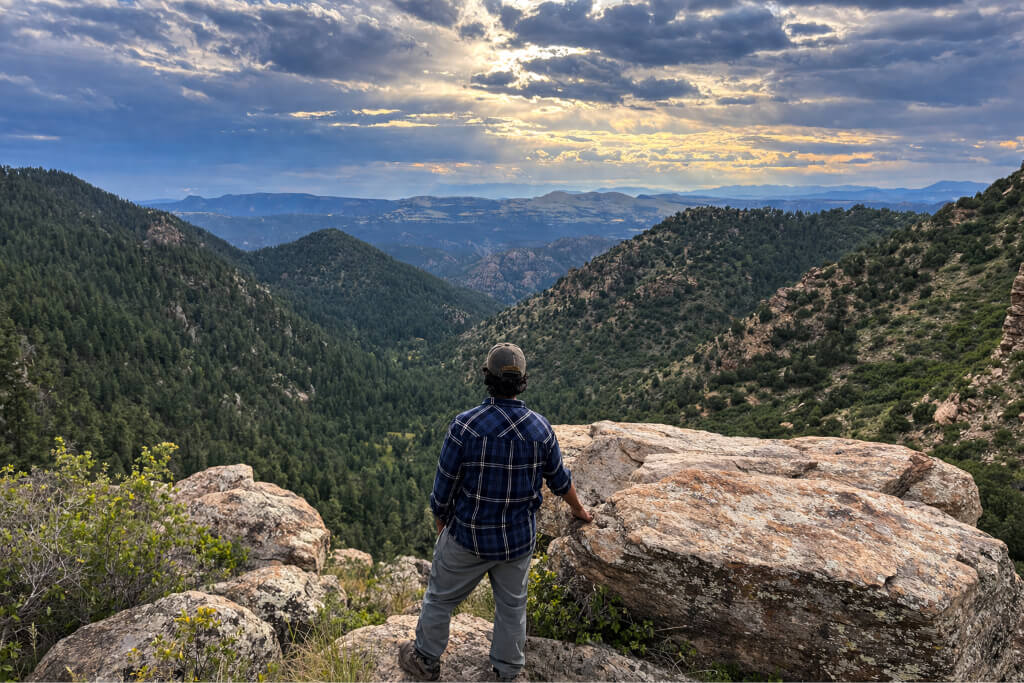
All photos in this article are real images taken during training at The Survival University and show actual skills and scenarios practiced in our field courses.

About the Author
Jason Marsteiner is the founder and lead instructor at The Survival University, where he’s turned his obsession with staying alive into a mission to teach real-world survival skills. Forget fancy gear, Jason’s all about the know-how that gets you through the wild or a city crisis. A published author of Wilderness Survival Guide: Practical Skills for the Outdoor Adventurer, he’s distilled years of hard-earned wisdom into lessons anyone can use.
Raised in Colorado’s rugged mountains, Jason’s survival chops were forged in the wild—from Missouri forests to Arizona deserts to Costa Rican jungles. He’s navigated it all with next to nothing, earning creds like Wilderness First Responder (WFR) and SAR tracking along the way. He’s trained thousands to keep cool when 911’s out of reach, proving survival’s not just for grizzled adventurers, it’s for hikers, parents, and city slickers alike.
Jason’s mantra? Everyone should make it home safe. When he’s not running courses, he’s designing knives, mentoring newbies, or chilling in the city like the rest of us, always sharpening the skills that turn panic into power.
