


March 3, 2026
How Survival Skills Build Leadership, Resilience, and Real World Decision Making
For a long time, I believed my job was to teach hard skills.
When I started teaching 15 years ago, that was the focus. Can you start a fire. Can you build a shelter. Can you purify water. Can you navigate from point A to point B without getting lost. Those were clear, measurable outcomes. A student either produced flame or they did not. They either arrived at the checkpoint or wandered off course. The skills were tangible and concrete.
And they still matter.
But over time I began to notice something that changed the way I teach.
Two students could receive the exact same instruction on a bow drill set. Same materials. Same explanation. Same demonstration. One would get frustrated almost immediately. They would rush. They would press too hard or not hard enough. They would burn through their fireboard. When the ember failed, they would feel like they failed. They would give up. The other student would slow down. They would adjust their stance. They would modify pressure. They would study the dust. They would change one variable at a time until it worked.
Same skill. Completely different internal response.
That was the moment I realized I was not just teaching fire. I was watching leadership, resilience, and troubleshooting unfold in real time.
The woods do not just test competence. They expose patterns.
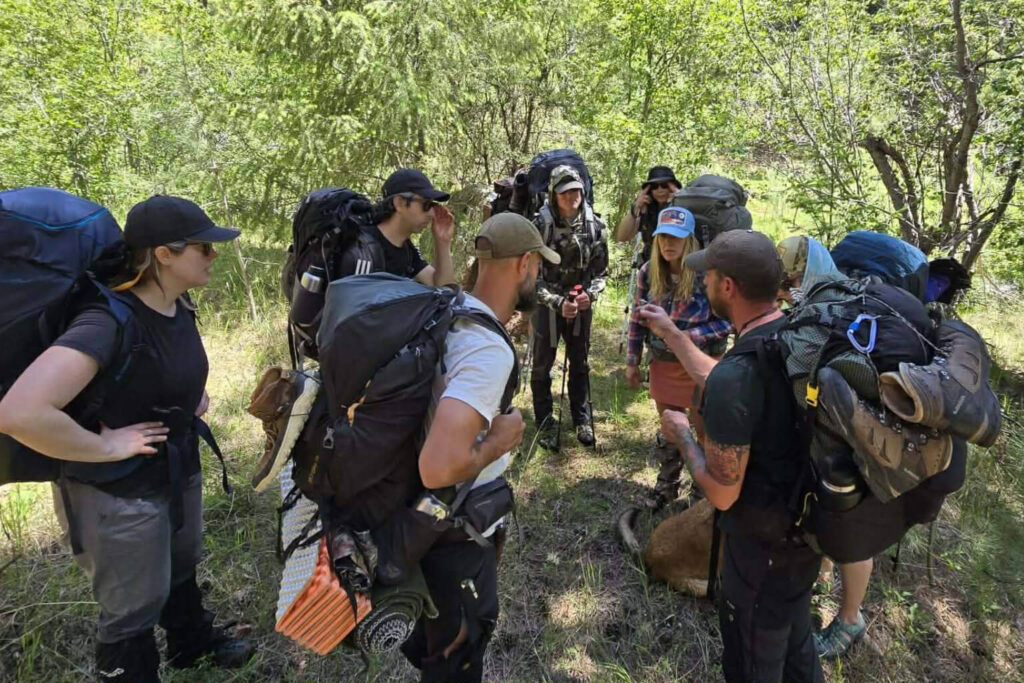
Instructor briefing students during a wilderness leadership training hike in Colorado. Field instruction like this teaches decision making, communication, and situational awareness in real terrain.
From Hard Skills to Real World Leadership Development
A short course does not have to be shallow. It only becomes shallow when we treat it that way. A weekend class can absolutely teach someone how to build a fire or construct a tarp shelter. It can introduce navigation. It can give someone a solid foundation in priorities and planning. There is nothing wrong with that. In fact, that foundation matters.
But foundation is not the same as development.
Development happens when the skill begins to press back on the person practicing it. When things do not go smoothly. When weather changes. When time runs short. When frustration rises. When ego gets involved. That is when a simple skill becomes a mirror.
What I learned over time is that the real value of those short programs depends entirely on intention. If the goal is simply to check the box and say you can light a fire, you will walk away with a technique. If the goal is to notice how you respond when the fire does not light, you walk away with awareness. If you pay attention to how you communicate when things are not going well, you walk away with leadership insight. If you observe how you make decisions under mild pressure, you walk away with something far more durable than a flame.
Real world leadership is rarely about grand moments. It is about small decisions made correctly and consistently under friction. It is about slowing down when others rush. It is about seeing what is actually happening instead of what you wish were happening. It is about adjusting early instead of defending a failing plan.
The woods simply compress that process. They make feedback immediate. They strip away distraction. They reveal how you actually operate when conditions are not perfect.
And that is where hard skills begin turning into leadership development.
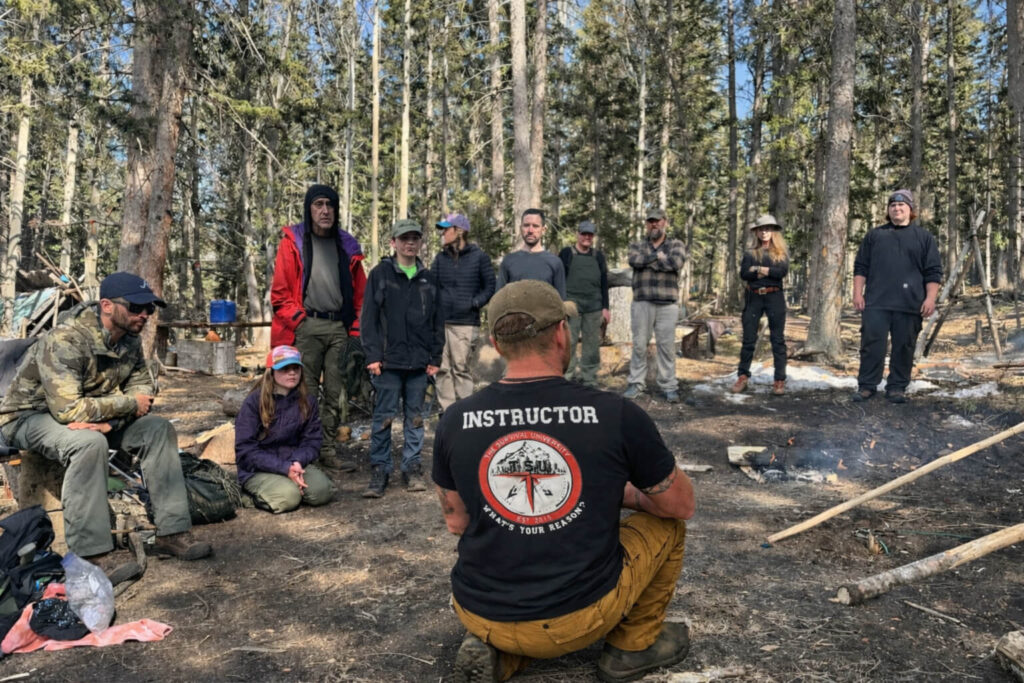
Instruction in the woods often begins with simple conversations like this. The techniques matter, but the real work begins when students start applying those skills and discovering how they respond when conditions are not perfect.
How Building a Fire Teaches Leadership, Patience, and Decision Making
Fire is one of the clearest teachers I know.
Anyone can be shown the steps. Gather the proper materials first. Tinder, kindling and fuel. Process it down. Build your fire lay. Protect from wind and rain. Allow airflow. Add your materials at the right time and be methodical. It is a sequence. But sequence under pressure reveals character. When the flame collapses, do you rush and smother it with more wood, or do you step back and assess what is actually missing. When the ember is fragile, do you force it or protect it. When the fire is finally established, do you abandon it or steward it.
A fire that lasts is not the result of one dramatic moment. It is the result of sustained attention over time. You feed it at the right moment instead of all at once. You anticipate what it will need before it begins to collapse. You notice subtle changes in wind and adjust your structure. You think ahead so you are not scrambling for fuel in the dark when energy is low and patience is thin.
And when the storm rolls in, you have choices. Do you ignore it and hope the fire holds. Do you throw more fuel on and create bigger flames that burn hot and fast. Or do you bank the fire, placing larger logs in a tight pattern, reducing oxygen, protecting the coals, and letting it burn steady and controlled through the weather. Those decisions matter. They are not dramatic. They are deliberate. And they determine whether the fire survives the night.
Every decision you make around a fire has consequence. Add fuel too early and you smother it. Wait too long and it dies. Ignore wind and you either fail to ignite in the first place or watch your flame disappear the moment it catches. Misjudge your materials and you waste energy. The fire does not reward emotion. It rewards observation and timing.
One of the most common mistakes I see is not failure to create flame. It is impatience once flame appears. A student will get a small, fragile fire going, just enough to look promising, and then immediately dump a large armful of fuel on top of it. They want a big fire now, so they use big wood. The result is predictable. The weight collapses the structure. Oxygen disappears. The small flame is smothered instantly. They are left with a little smoke and a lot of regret.
It is the equivalent of stomping on something that just began to grow.
A small fire requires small fuel. Properly processed tinder and kindling. Sometimes even backing up and adding finer material again if the flames start to die down. You match the size of the fuel to the strength of the flame. Only when the thicker kindling burns hot can you begin introducing larger pieces of fuel. Fire rewards sequencing. It punishes ego, impatience, and shortcuts.
That same pattern shows up in work, leadership, and personal growth. People want scale before stability. They want intensity before structure. They try to apply heavy pressure to something that has not yet built the foundation to carry it. Projects collapse. Teams burn out. Momentum dies.
Growth, like fire, requires proportional input. Build the base. Strengthen the coal bed. Then increase intensity. That is decision making under pressure in its simplest form.
Stewardship like that teaches patience and follow-through in a way no lecture ever could. It forces presence. It rewards discipline and exposes carelessness without emotion. And if you pay attention, it teaches something even deeper. Leadership is not about intensity. It is about awareness, timing, sequencing, and the willingness to make small corrections before small problems become large ones.
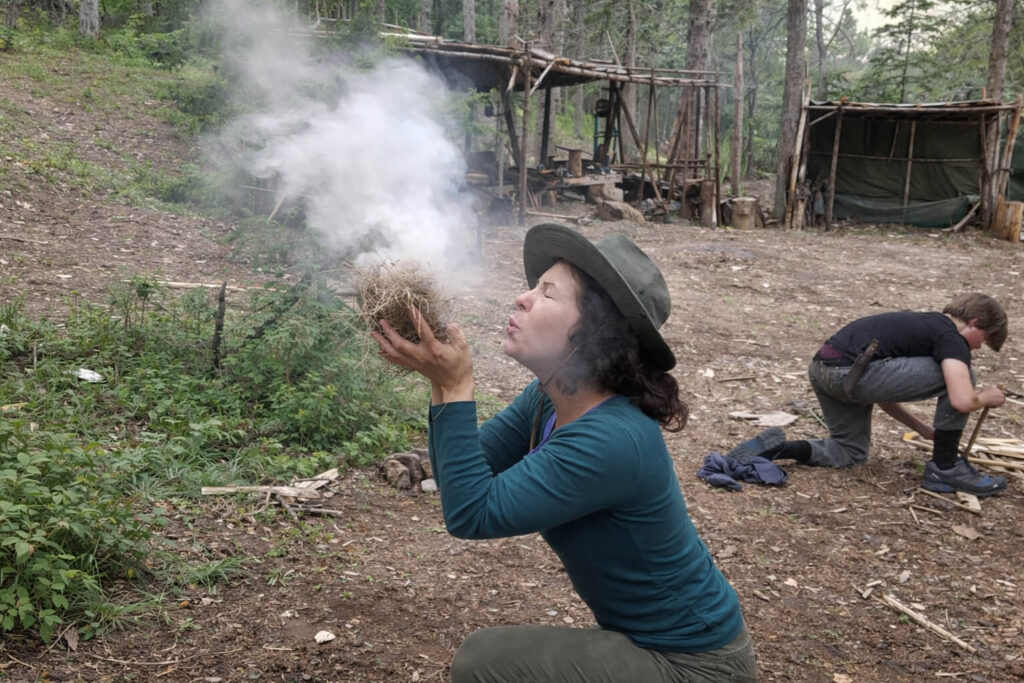
A student working to ignite a tinder bundle during primitive fire training. The process requires patience, persistence, and careful control of airflow.
Why Overconfidence Undermines Leadership Under Pressure
On fire day, especially when I am working with experienced groups or military Special Forces teams, I often begin with a simple question.
How many of you are good at building fires?
Most hands go up.
Nearly everyone believes they are competent. They have done it before. They have been in the field. They have lit plenty of comfortable campfires with familiar gear in controlled environments. There is confidence in the room, and sometimes pride. On the surface, that confidence is not misplaced. Many of them have produced flame more than once.
Then I begin removing things.
I take away the lighter they normally carry. I remove the ferro rod. I limit materials. I change the environment. I introduce variables that are not dramatic, just realistic. Damp fuel. Awkward terrain. Wind that will not cooperate. Limited time. The kinds of inconveniences that actually happen outside when conditions are less than ideal.
And the majority of them fail.
Not because they are incapable. Not because they lack strength or intelligence. They fail because they assumed they already knew. When I taught the fundamentals earlier, some of them were hearing the instruction but filtering it through what they believed they already understood. They thought they possessed the skill, so they stopped paying attention to the finer points. Material type. Processing. Airflow. Structure. Moisture content. Sequencing. Small details that only matter when comfort is stripped away.
When the tools disappear, the illusion disappears with them.
That moment is not about embarrassment. It is about calibration. It is about bringing perception back in line with reality.
I humble them because I need to. Because they need it.
After that first failure, I step back and teach it again. The same fundamentals. The same sequencing. The same attention to detail.
This time, they listen differently. The posture shifts. They ask better questions. They slow down. They observe airflow instead of forcing flame. They think about structure instead of relying on shortcuts. They become students instead of performers. Most of them succeed the second time because now they are present.
There are always a few who resist the process. Not because they lack ability, but because the method they relied on did not produce the outcome they expected. Instead of adjusting, they try to force their original approach again. They press harder. They move faster. They double down on what just failed. That is a very human response.
When something we believe should work does not work, the instinct is often to apply more effort rather than reconsider the structure. But force rarely fixes a flawed process. It usually exposes it. Those students require more work because they are still attached to their first assumption. The shift happens when they are willing to pause, detach from ego, and try a different approach. When that happens, progress accelerates.
That exercise is not really about fire.
It is a leadership lesson disguised as a fire lesson.
Competence without humility is fragile. Assumption blocks growth. Real capability is built when you are willing to uncover the gaps in your understanding, own them without defensiveness, and correct them. The flame is just feedback. The deeper work is internal.
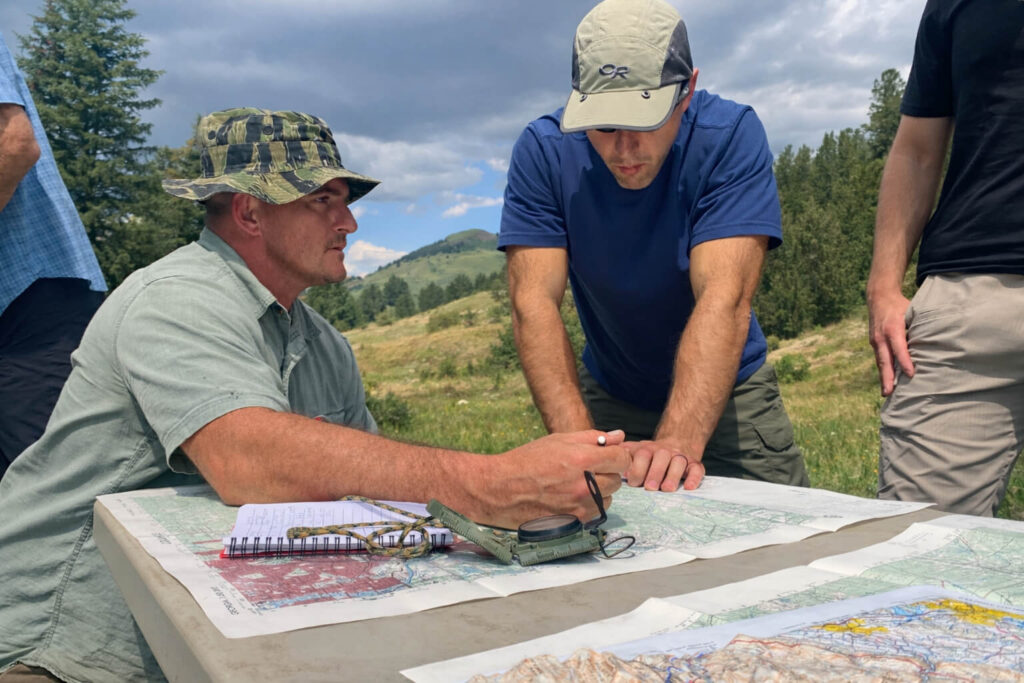
Students studying terrain with map and compass during navigation training. Navigation exercises teach judgment, patience, and adaptive decision making under real conditions.
Troubleshooting and Adaptive Leadership in the Field
The same pattern shows up in navigation. It is not just about knowing how to use a compass. It is about stopping when you are uncertain instead of walking faster to outrun doubt. It is about orienting yourself before committing. It is about reading terrain instead of blindly trusting a line on a map, or following that line without recognizing how it could lead you straight into a terrain trap.
A map shows distance, direction, elevation, and terrain features if you know how to read it. The information is there. But information is not judgment. Contour lines do not automatically translate into understanding. A map cannot account for your fatigue, loose scree underfoot, thick deadfall, unexpected cliffs, or the way a drainage funnels you somewhere you do not want to be. That is where interpretation comes in. You have to reconcile what the map suggests with what the ground is actually telling you.
In one advanced course, a team had a choice between a steep 1000 foot climb that was roughly 1.5 miles as the crow flies, or an old winding 4×4 road that stretched the route closer to 4 miles but climbed the same elevation more gradually. They chose the longer road. The decision itself was not wrong. The issue was attention.
The road they needed to take was clearly marked on the map, with a defined backstop just beyond it. They missed the turn and failed to recognize the backstop. They were talking, moving comfortably, and not reading terrain. They walked roughly 4 miles past the correct junction before something felt off. Only then did they stop, sit down, and reconcile the map with the ground.
They had to walk 4 miles back to the missed turn, then complete the proper 4 mile approach. A route that should have cost 4 miles ended up costing 12.
They corrected the mistake. That matters. But the lesson was clear. Small lapses in awareness compound quickly. The later you correct, the more expensive the correction becomes.
Navigation errors are usually less about tools and more about timing and attention. They happen because someone is uncomfortable with uncertainty. They keep moving when they should pause. They let ego or momentum override data. They convince themselves they are close enough instead of confirming.
When someone learns to stop, gather information, isolate the limiting factor, and make a small correction, they are practicing real troubleshooting. They are separating emotion from analysis. They are learning to make adjustments early instead of paying for them later.
Observe. Identify the problem. Adjust. Reassess. Repeat.
That loop is not just for the field. It is the same loop used in business, relationships, and leadership. The terrain simply makes the feedback obvious. If you drift off course, the map does not argue with you. It quietly proves you wrong.
Adaptive leadership begins with the willingness to pause long enough to see what is actually happening.
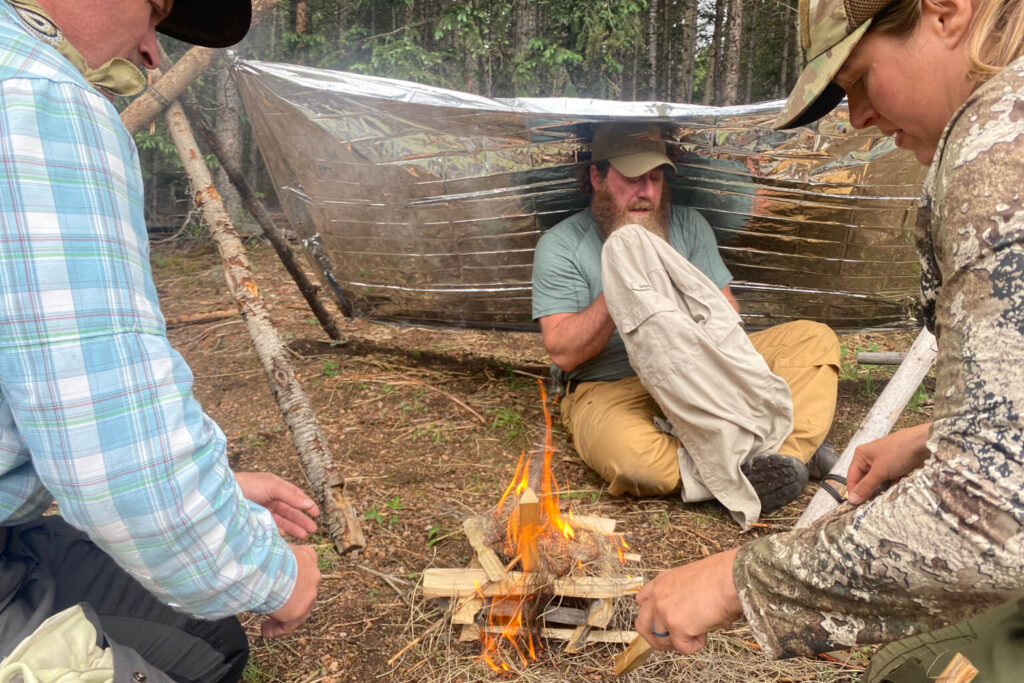
Students building fire while sheltered from wind and rain. Combining shelter and fire skills teaches sequencing and calm decision making under pressure.
Situational Awareness as a Core Leadership Skill
Over the years, I also began to understand how much awareness feeds all of this.
I do not chew gum when I hike. I do not listen to music when I am walking. I rarely even listen to music when I am driving. That is not about being intense. It is about reducing noise so I can hear everything going on around me. When you constantly stimulate your senses, you flatten them. When you remove some of that input, subtle information becomes available again. You notice shifts in wind. Changes in moisture. Birds going quiet. The faint smell of rain before it arrives. You walk softer. You speak less. You see more.
Most people are loud without realizing it, physically and mentally. The woods teach you that information is always present, but only if you are quiet enough to receive it.
That kind of awareness is not mystical. It is practical. It is the same awareness that lets you sense tension in a room before anyone speaks. It is the same awareness that tells you a plan feels off before the numbers prove it. It is the same awareness that helps you catch your own frustration before it spills onto someone else. The woods simply provide a clean environment where feedback is immediate and honest.
Over time, that repeated exposure builds pattern recognition. When you spend years working in unpredictable environments, you begin to recognize subtle signals before they escalate. You notice shifts in behavior. You see weather building before it fully arrives. You sense when a plan is beginning to drift off course before the failure is obvious. That is not paranoia. It is accumulated data. It is the nervous system cataloging patterns and learning from them. The more disciplined your training across different skills, the more those patterns begin to connect across human behavior, environmental signals, and risk indicators. You start to anticipate rather than react.
I can often make educated assessments about how a situation is likely to unfold, or why it unfolded the way it did, not because I am guessing, but because I have seen similar sequences play out before. That awareness has kept me out of bad terrain, out of unnecessary conflict, and out of preventable mistakes more than once. It is not about assuming danger is everywhere. It is about recognizing when something is off early enough to adjust.
That early recognition is what leadership actually looks like.
In the field, leadership is rarely loud. It is rarely dramatic. It is the ability to see what is developing before everyone else feels it. When people are cold, tired, or frustrated, someone has to prioritize correctly. Fire and shelter before comfort. Water before food. Structure before speed. The person who can interpret the environment accurately, communicate simply, and regulate their own energy becomes the stabilizing force.
That does not require months in the backcountry, but it does require intentional practice. In a short course, we can rotate responsibility. We can let someone else manage time. We can let someone else lead a task. We can debrief not just the outcome, but how decisions were made and when they were made.
If you approach the weekend that way, it becomes more than exposure. It becomes a mirror.
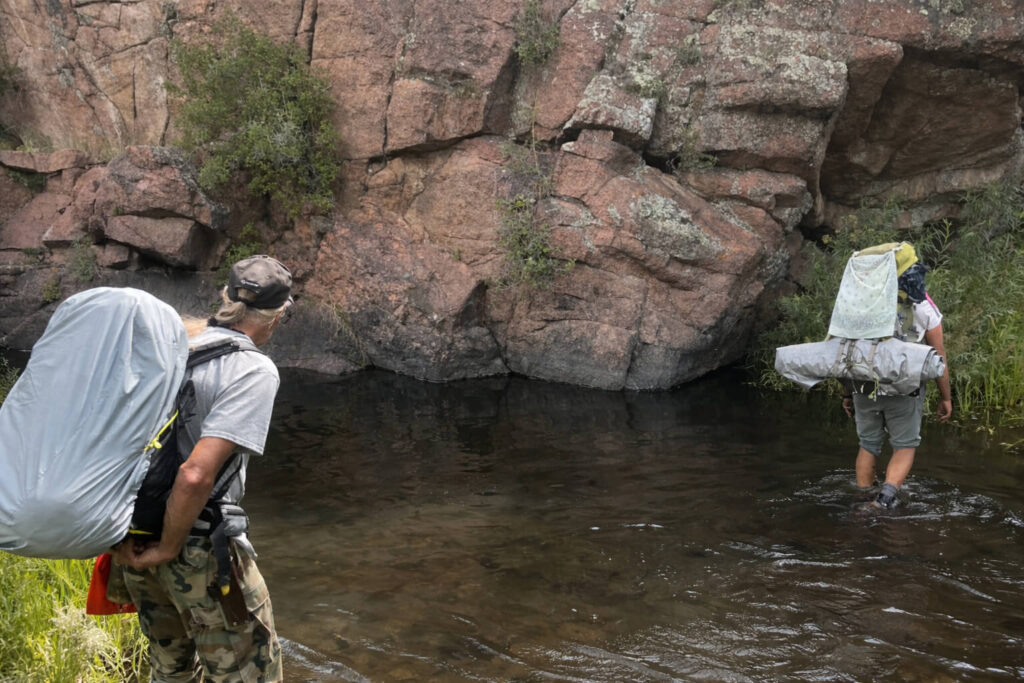
Students crossing a mountain stream during a field exercise. Terrain movement builds awareness, route planning skills, and leadership under real environmental conditions.
Why Leadership and Resilience Require Repetition, Not Just Exposure
Depth, however, still requires repetition.
A weekend introduces stress in small doses. It exposes patterns. It gives language and context. But exposure alone does not rewire behavior. It simply reveals it. Long term change comes from returning to the environment, practicing again, and stacking experience on top of experience.
The first time someone gets frustrated, they may not handle it well. The second time, they catch it sooner. The third time, they adjust before it escalates. Over time, that adjustment begins happening almost automatically. What was once a reaction becomes a response. That progression is growth. It does not happen in one shot. It happens through repetition.
Resilience is not built by a single hard moment. It is built by dozens of uncomfortable ones. Each repetition builds internal reference points. The nervous system learns that discomfort is not danger. The mind learns that confusion is not failure. Confidence stops being theoretical and becomes earned.
Immersive programs accelerate that process because friction is sustained. Fatigue sets in. Weather shifts. Novelty fades. When comfort is limited for days or weeks, your default patterns cannot hide. Under sustained stress, shortcuts fail. Ego cracks. Adaptation becomes necessary.
That is where deeper mental strengthening occurs.
But not everyone needs a long immersion to benefit. What they need is repeated exposure with intention. When you revisit discomfort deliberately, you begin to change your relationship with it. And that relationship is what ultimately determines how you lead under pressure.
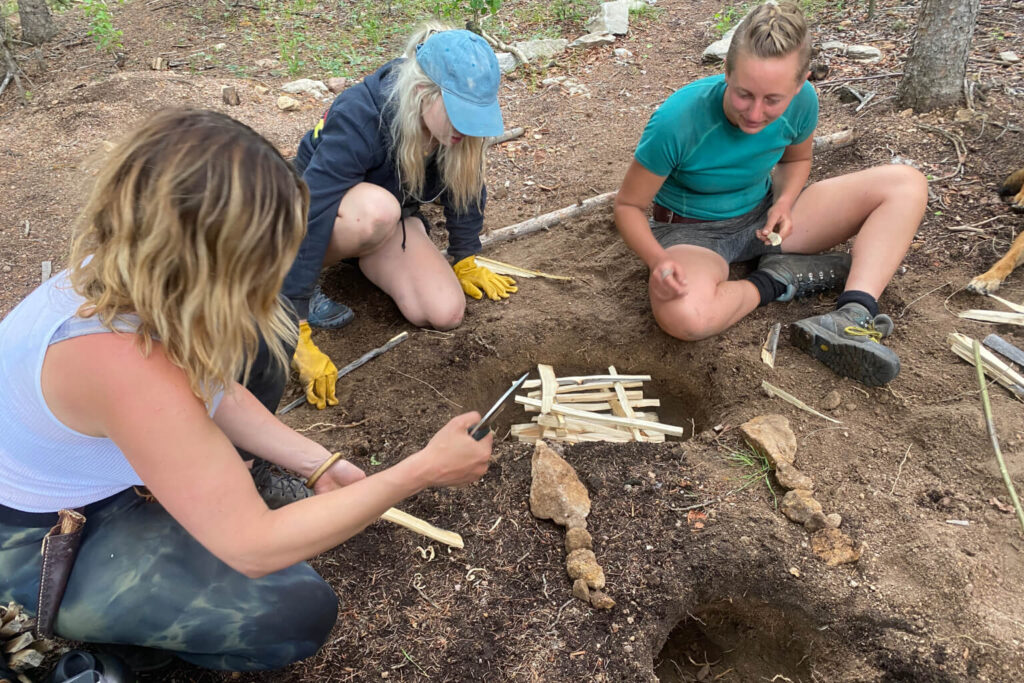
Students practicing fire lay construction during survival training. Repetition builds confidence and exposes mistakes in sequencing, airflow, and fuel selection.
What Happens When Performance Falls Away: The 50 Day Transformation
I see it every year in the 50 Day program.
When students first arrive, they are tight. You can see it in their posture and hear it in their voice. They are about to spend 50 days in the woods with people they barely know, led by a bearded mountain man they have only read about online. They are stepping away from routine, control, image, and predictability. They arrive civilized in the modern sense. Concerned with appearance. Guarded. Carrying the pace and tension of their normal life. Even when excited, they are wound up. They move a little fast. They talk a little too much. They are still managing how they are perceived.
Then we start working.
We build shelters. We manage water. We make fire in wind and rain. We deal with cold mornings and long days. We solve small problems repeatedly. They fail safely. They adjust. They get tired. They get dirty. They begin relying on each other instead of performing for each other.
And then one morning, usually a couple weeks in, I walk into camp and something has shifted.
No announcement. No ceremony. Just a quiet change.
They are not prim and proper anymore. The city posture is gone. They sit differently. Move differently. Less guarded. Less polished. More relaxed. There is soot on their faces and dirt on their clothes and they are no longer self-conscious about it. Their hair is wild. Their pace has slowed. Their eyes are clearer.
They look almost feral.
Not reckless. Not chaotic. Just stripped of performance. The polish has worn off. The social armor has thinned. They are not acting wild. They are simply no longer performing.
They look more grounded. Closer to their original wiring. More honest in their movements and reactions.
That is the moment I usually think to myself, “There you are. Now we can really begin.”
Because at that point the performance layer has fallen away. The ego is quieter. The nervous system has settled. They are no longer trying to prove something. They are simply present. Once that happens, both the hard skills and the internal work deepen dramatically. Instruction lands differently. Feedback is received differently. Leadership begins to emerge naturally instead of being forced.
That shift does not come from a lecture. It comes from sustained exposure to friction in an environment that does not care about your résumé, your social media image, or your title. It comes from repetition. From being slightly uncomfortable long enough that layers of societal conditioning begin to peel away and something more fundamental steps forward.
The woods do not just teach skills. They reveal who you are when the distractions fall away.
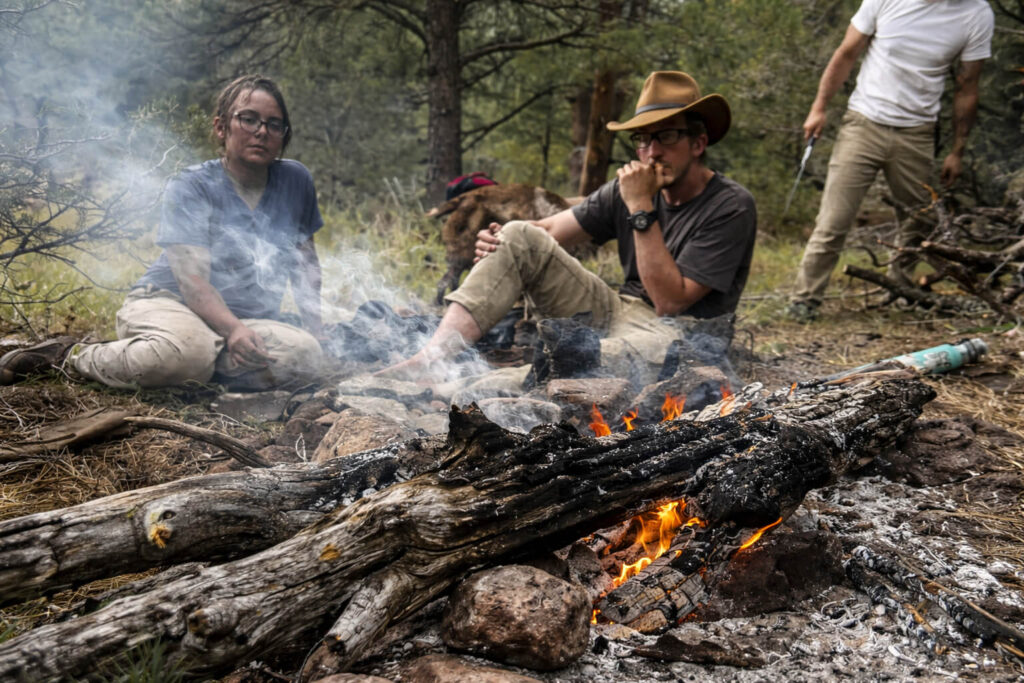
Students gathered around a campfire during the 50 Day Wilderness Immersion program. Long term training allows resilience and leadership patterns to emerge naturally.
Using Survival Skills to Build Leadership and Character
The hands on skills are the vehicle. They give us something real to work with. They create consequences that matter without putting anyone in unnecessary danger. They provide friction in a controlled setting. You can build it wrong and watch it fail. You can adjust and watch it work. You can feel the difference between rushing and structuring.
Through that process, people steady themselves. They learn to troubleshoot instead of panic. They learn to build the foundation before increasing intensity. With fire, that means establishing proper tinder and airflow before adding larger fuel. With navigation, it means confirming direction before committing fully.
If you just want to learn fire and check that box, I will teach you fire. I will show you the sequence and help you produce flame. But if you want to become more capable, steadier, and more aware, I will do that through fire. The sticks and tinder are tools. What we are really training is patience, emotional control, sequencing, follow through, and stewardship. The skill is the doorway. What you build inside yourself while practicing it is the real work.
After 15 years, I still teach fire, shelter, water, navigation, and the fundamentals. The curriculum has not changed nearly as much as my perspective has. I no longer see those subjects as isolated competencies. I see them as tools for shaping awareness. As frameworks for leadership under mild but real stress. As laboratories where resilience is tested in small, repeatable doses. The woods give instant feedback. The lesson is not just whether the shelter stands or the fire continues to burn. The lesson is how you handled yourself while building it.
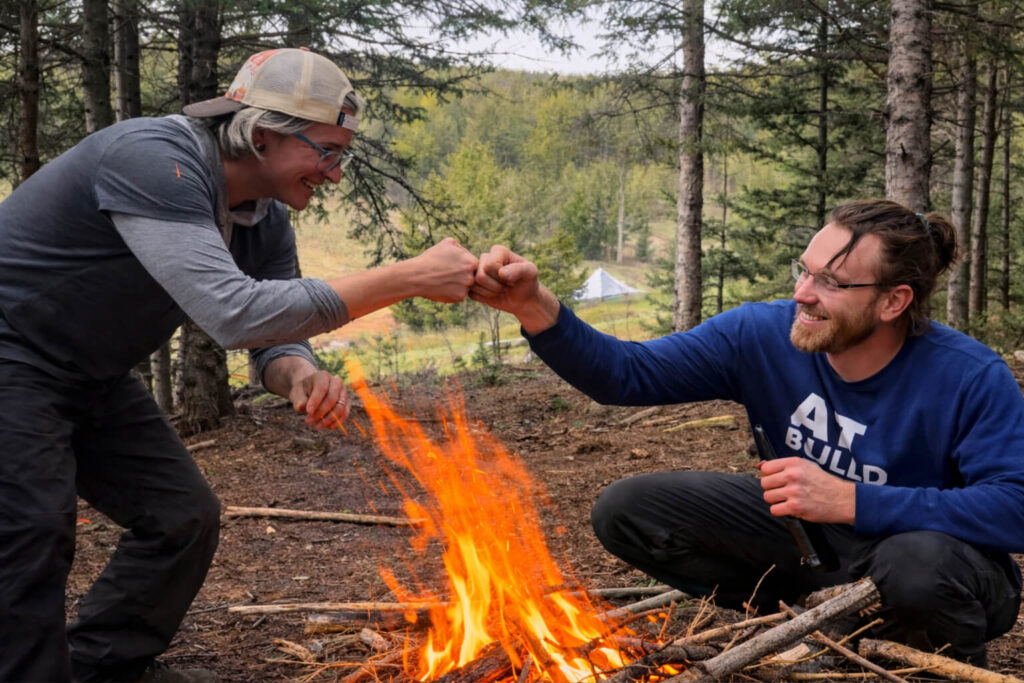
Students celebrate after successfully starting a fire. Fire building teaches patience, observation, and structured problem solving.
From Weekend Skills to Long Term Leadership Growth
A short class can plant the seed. It can introduce language, structure, and the first taste of friction. The depth of what you gain depends on how you show up. If you are only looking for flame, you will leave with flame. If you are willing to examine your reactions, pacing, communication, and decision making, you can walk away with a different way of thinking.
Return to the training. Expose yourself to controlled discomfort again. Pay attention to how you respond under pressure. That is where growth happens. Those lessons do not fade. They compound quietly over time, shaping the way you move through the world long after the fire has burned out.
The goal is not simply to know how to survive in the woods. The goal is to become more capable, more attentive, and steadier wherever you are. The woods are just one of the clearest classrooms I have found for building that kind of leadership.
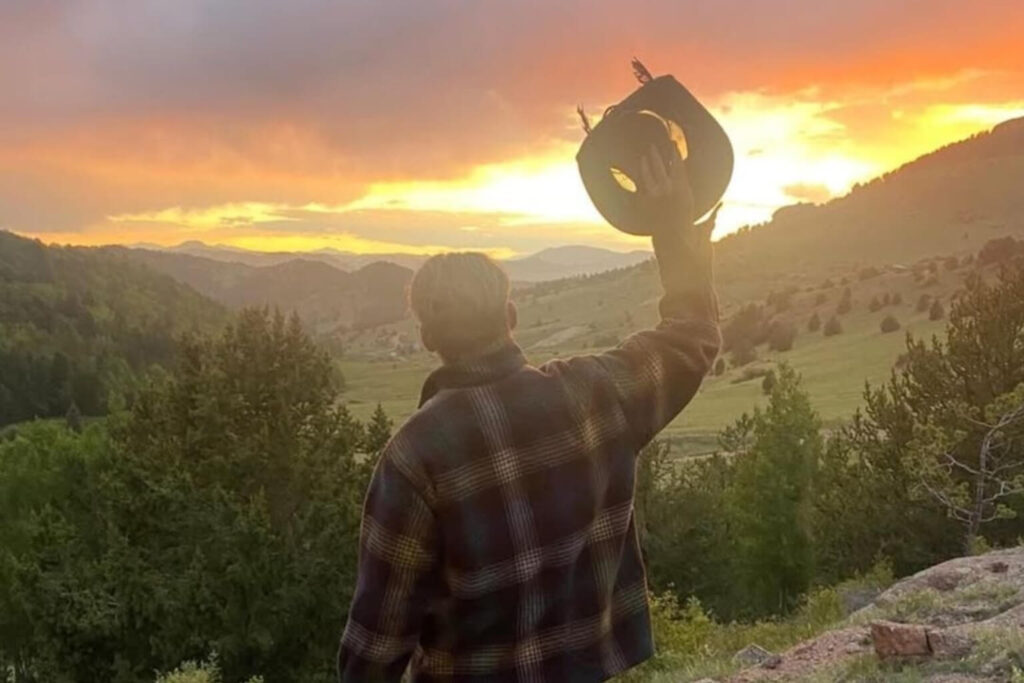
An instructor overlooking the Colorado mountains at sunset during wilderness leadership training. Time in wild places builds awareness, resilience, and clarity.
About the Author
Jason Marsteiner is the founder and lead instructor at The Survival University, where he’s turned his obsession with staying alive into a mission to teach real-world survival skills. Forget fancy gear, Jason’s all about the know-how that gets you through the wild or a city crisis. A published author of Wilderness Survival Guide: Practical Skills for the Outdoor Adventurer, he’s distilled years of hard-earned wisdom into lessons anyone can use.
Raised in Colorado’s rugged mountains, Jason’s survival chops were forged in the wild—from Missouri forests to Arizona deserts to Costa Rican jungles. He’s navigated it all with next to nothing, earning creds like Wilderness First Responder (WFR) and SAR tracking along the way. He’s trained thousands to keep cool when 911’s out of reach, proving survival’s not just for grizzled adventurers, it’s for hikers, parents, and city slickers alike.
Jason’s mantra? Everyone should make it home safe. When he’s not running courses, he’s designing knives, mentoring newbies, or chilling in the city like the rest of us, always sharpening the skills that turn panic into power.
